Rice-to-Water Ratio: Why You Can't Just Double It (2026)
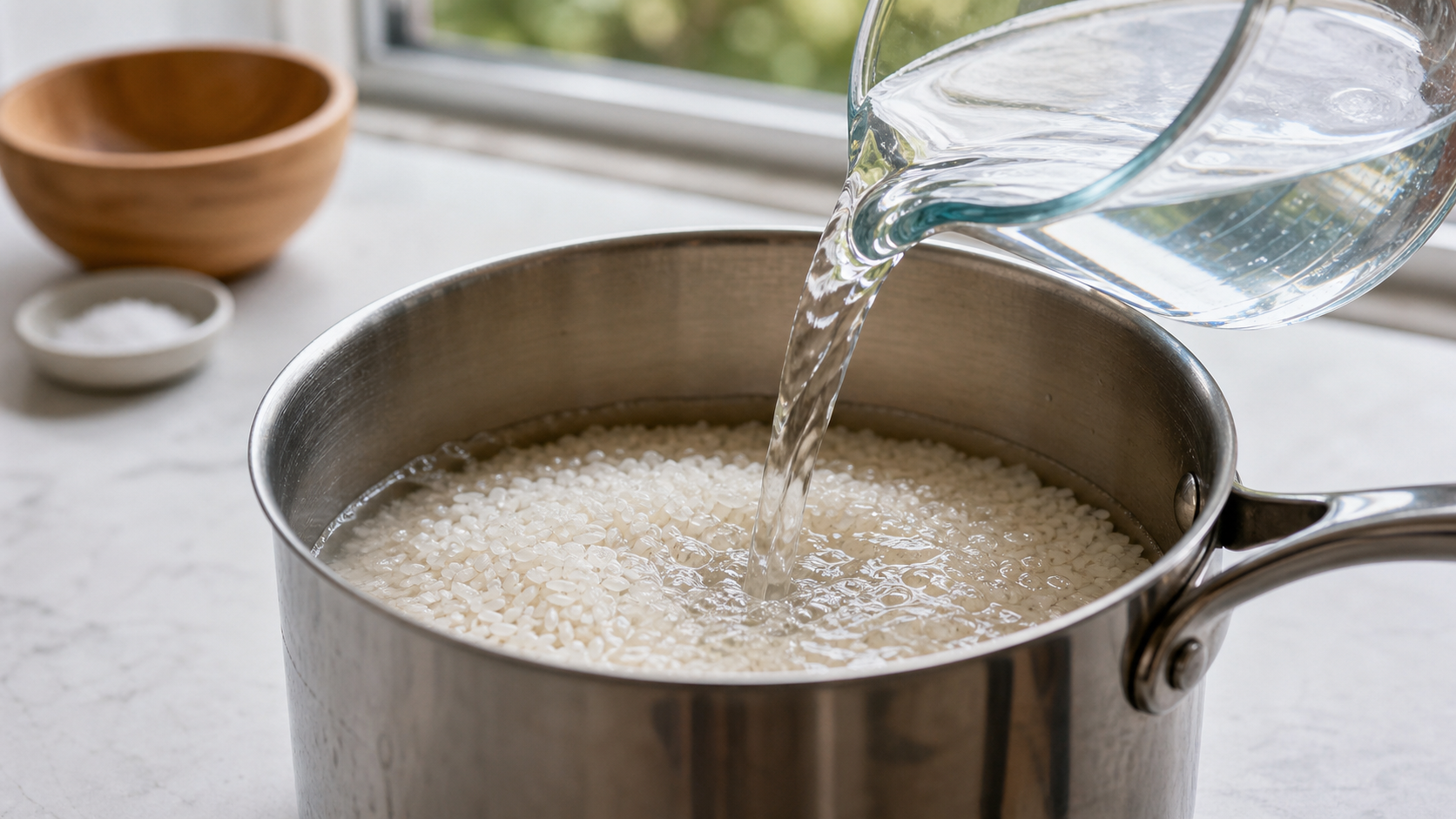
The bag says 1 cup of rice needs 13⁄4 cups of water. You're cooking for six people, so you triple the rice — and obediently triple the water. The result? Porridge. Or you hold back and end up with crunchy undercooked grains. The ratio is not broken; the assumption is. Scaling rice is not a linear operation, and there's a clean physical reason why.
This article explains the two separate processes that consume water when you cook rice, derives a simple approximate model that shows why the ratio must change with batch size, and walks through concrete examples for 1 cup, 3 cups, and the rice cooker case. All numbers cited are conventional guidance and should be treated as starting points, not precision measurements — your pot, lid, stove, and rice brand will influence the result.
The Standard Ratios: A Starting Point
Standard rice-to-water ratios vary by rice type, typically ranging from about 1:1.1 for short-grain sushi rice to 1:2.5 for brown rice. These ratios are calibrated for a small, single-serving batch in a standard covered pot — usually 1 to 2 cups of dry rice. They are useful starting points, but they were never designed to be scale-invariant.
Cooking references, rice brand instructions, and kitchen science books (notably J. Kenji López-Alt's The Food Lab and resources from America's Test Kitchen) broadly agree on the following as conventional starting ratios. Individual results will vary.
| Rice Type | Standard Ratio (rice : water) | Cook Time (approx.) | Notes |
|---|---|---|---|
| White, long-grain | 1 : 1.75 – 2 | 18 min | Most common. Ratio varies by brand and altitude. |
| White, short-grain (sushi) | 1 : 1.1 – 1.25 | 15 min | Often rinsed; stickier starch absorbs water differently. |
| Basmati | 1 : 1.5 | 15–18 min | Usually soaked and rinsed; pre-soaking reduces absorption need. |
| Jasmine | 1 : 1.5 | 18 min | Similar to long-grain; slightly stickier result expected. |
| Brown rice | 1 : 2 – 2.5 | 40–45 min | Bran layer slows absorption; longer cook = more evaporation loss. |
The immediate puzzle: if these ratios are determined experimentally for a 1-cup batch, what should you actually use for a 3-cup batch? Naively scaling the ratio gives the wrong answer — and understanding why requires looking at what water actually does during cooking.
Why Doubling Rice Doesn't Mean Doubling Water
When you cook rice, water disappears through two entirely different physical processes: absorption into the rice grains and evaporation as steam. Absorption scales with the amount of rice — more grains means more water soaked up. Evaporation, however, depends on your pot's surface area, the tightness of the lid, and how long the heat runs — none of which change much when you add more rice to the same pot.
Because these two processes have different scaling behavior, the total water needed is the sum of two differently-behaved terms — not a single ratio times the rice quantity. Here is the essential distinction:
The practical consequence: when you cook a small batch of rice, evaporation is a large fraction of the total water used. When you scale up to a big batch in the same pot, the absorption portion grows with the rice, but the evaporation portion stays roughly the same. So the fraction of water that "isn't actually feeding the rice" shrinks — and the effective ratio falls.
This also explains why rice cookers give a different ratio than stovetop methods. A sealed rice cooker returns condensed steam back into the pot, dramatically reducing evaporation loss. The ratio is closer to pure absorption. An open pot or a pot with a poorly fitting lid allows far more steam to escape, so a higher ratio is needed to compensate.
The Simple Model: Water = a · Rice + b
The water you need can be approximated as a linear function of rice quantity, not a constant ratio: Water equals an absorption coefficient times the rice amount, plus a fixed evaporation offset. This model makes explicit that the ratio (water divided by rice) changes with batch size — because the fixed term gets diluted as rice increases. The formula is conceptual and approximate; treat it as a thinking tool, not a recipe calculator.
The standard ratio on a bag is implicitly derived from this formula at one specific rice quantity — let's call it R₀. When you compute Water / Rice using the formula above, you get:
As Rice increases, b/Rice shrinks. The effective ratio decreases. This is why large batches need a lower water-to-rice ratio than small batches — the evaporation offset becomes a smaller fraction of the total.
How Pot Size and Lid Tightness Affect the b Term
| Cooking Setup | Evaporation (b) Effect | Ratio Implication |
|---|---|---|
| Tight lid (Dutch oven, heavy pot) | Low — steam condenses and drips back in | Use less water |
| Standard lid (medium fit) | Moderate — some steam escapes | Use standard ratio |
| Loose lid or glass lid (rattles) | Higher — more steam loss around rim | Add a splash more |
| No lid (open pot) | Very high — continuous steam escape | Significantly more water |
| Wide shallow pan (same volume) | Higher — more surface area exposed | Add more water |
| Rice cooker (sealed, condensing) | Near zero — steam returns as liquid | Much less water needed |
Worked Examples: 1 Cup vs. 3 Cups vs. Rice Cooker
Using the approximate model with white long-grain rice (a ≈ 1.25, b ≈ 0.50 cups for a standard covered pot), 1 cup of rice requires about 1.75 cups of water — a ratio of 1:1.75, matching the bag instruction. Three cups of rice in the same pot requires only about 4.25 cups — a ratio of roughly 1:1.42, not 1:1.75. A rice cooker, where evaporation is near zero, needs only about 1.1–1.2 cups of water per cup of rice regardless of batch size.
These numbers are illustrative estimates derived from the model structure, not precision measurements. Your actual results will vary based on your equipment. The goal is to show the shape of the relationship, not to provide a universal recipe.
Example 1 — 1 Cup White Rice (standard covered pot)
Example 2 — 3 Cups White Rice (same pot, same lid)
Example 3 — 2 Cups White Rice in a Rice Cooker (evaporation ≈ 0)
Ratio Comparison at Different Batch Sizes (approximate, standard covered pot)
| Dry Rice | Absorption (a·R) | Evaporation (b) | Total Water | Effective Ratio |
|---|---|---|---|---|
| 0.5 cup | ≈ 0.63 cups | ≈ 0.50 cups | ≈ 1.13 cups | 1 : 2.26 |
| 1 cup | ≈ 1.25 cups | ≈ 0.50 cups | ≈ 1.75 cups | 1 : 1.75 (bag standard) |
| 2 cups | ≈ 2.50 cups | ≈ 0.50 cups | ≈ 3.00 cups | 1 : 1.50 |
| 3 cups | ≈ 3.75 cups | ≈ 0.50 cups | ≈ 4.25 cups | 1 : 1.42 |
| 5 cups | ≈ 6.25 cups | ≈ 0.55 cups | ≈ 6.80 cups | 1 : 1.36 |
The table shows the trend clearly: as batch size grows, the effective ratio drops. A half-cup batch is dramatically affected by evaporation; a five-cup batch barely notices it. These numbers use a single illustrative model (a = 1.25, b = 0.50) for white long-grain rice in a standard covered pot. Your mileage will vary — but the direction of the effect is universal.
Frequently Asked Questions
Why does rice need less water when you cook more?
Because water is consumed by two separate processes: absorption (which scales with rice quantity) and evaporation (which depends on your pot, lid, and cooking time — not on how much rice is inside). When you cook a large batch, the fixed evaporation loss becomes a smaller fraction of the total water used, so the water-to-rice ratio decreases. This is not an error in the bag instructions — those ratios are calibrated for a specific small batch size.
What is the correct rice-to-water ratio?
There is no single correct ratio — it depends on rice type, batch size, pot, lid, stove, and altitude. Commonly cited starting points for a small covered-pot batch: white long-grain 1:1.75–2, basmati 1:1.5, jasmine 1:1.5, sushi rice 1:1.1–1.25, brown rice 1:2–2.5. For larger batches in the same pot, reduce the ratio by roughly 10–15%. For a rice cooker, use the appliance's own measuring markings, which are calibrated for near-zero evaporation.
Does the rice-to-water ratio change with the amount of rice?
Yes. The relationship between rice quantity and water needed is linear (Water = a · Rice + b), not a fixed ratio. As rice quantity increases, the fixed evaporation offset (b) becomes a smaller fraction of the total water, so the effective ratio (Water / Rice) decreases. Doubling the rice does not mean doubling the water — you should add less than double, because evaporation stays roughly constant.
How much water do I need for 2 cups of rice?
For white long-grain rice in a standard covered pot, roughly 3 cups of water is a reasonable starting point for a 2-cup batch — a ratio of about 1:1.5, somewhat below the 1:1.75 ratio you'd use for 1 cup. This reflects the fact that evaporation is a proportionally smaller factor in the larger batch. If your pot has a tight lid, use slightly less; if it has a loose lid or you cook at high altitude, use slightly more. Adjust based on your results.
Why does my rice turn out mushy or dry?
Mushy rice usually means too much water relative to the rice quantity — which often happens when you scale up a small-batch ratio to a large batch without reducing it. Dry or crunchy rice usually means too little water, which can happen when you use a rice cooker ratio on the stovetop, or when your lid is very loose and more steam escapes than expected. The fix in both cases is to understand whether absorption or evaporation is off, adjust accordingly, and note the result for next time.
Does the type of rice affect the water ratio?
Yes, significantly. Rice type affects the absorption coefficient (a in the model) because different varieties have different starch structures and grain geometries. Short-grain sushi rice absorbs water very efficiently and needs far less than brown rice, which has an intact bran layer that slows water uptake and requires a longer cook time — meaning more evaporation too. Rinsing rice removes surface starch, which slightly lowers the water needed. Soaking before cooking pre-loads some water into the grain, also reducing the cooking water required.
Get new posts by email
No ads. Unsubscribe anytime.
Comments
Comments (0)
Leave a Comment