Brine Ratio: The Salt Percentage That Makes Meat Juicy
A cook's trick for tender chicken and pork that turns out to be a lesson in osmosis
You have probably noticed it without knowing why. The roast chicken at a good restaurant is somehow juicy all the way through, the pork chop stays tender even when it is cooked a touch past medium, the Thanksgiving turkey doesn't dry into sawdust. The cooks behind those plates almost always did one quiet thing first: they put the meat in salt. Either a tub of salty water, or a dry rub left to sit overnight. That step is brining, and it is the closest thing home cooking has to insurance against dry meat.
Here is the part the recipes rarely say out loud. A good brine is not a vibe or a secret blend — it is a percentage. How salty, relative to the water or the meat, is the only number that really matters, and once you can read it, you can brine anything without a recipe. The flavor is cooking; the reason it works is straight-up physics. Brining is osmosis with a chef's hat on.
What Salt Percentage Should a Brine Be?
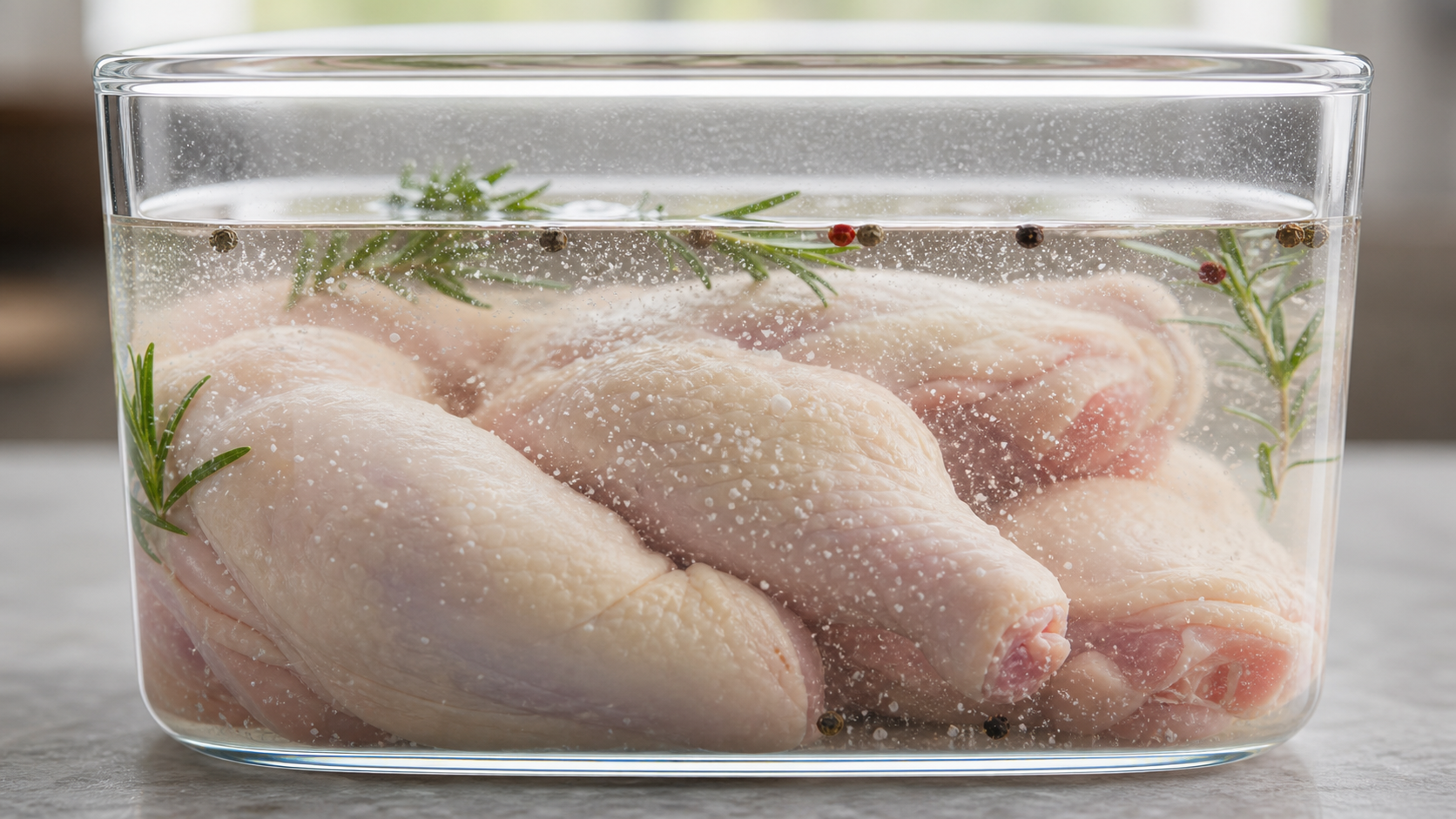
For a wet brine, aim for roughly 5–8% salt by the weight of the water — about 50–80 grams of salt per liter (1000 grams) of water. For a dry brine, where you salt the surface and let it sit, use about 0.75–1% salt by the weight of the meat, which is roughly three-quarters to one teaspoon of kosher salt per pound. Both are percentages, not fixed amounts, so they scale to any size bird or batch by simple multiplication. The wet number is bigger because it must season a whole tub of water; the dry number is smaller because all of it goes straight onto the meat.
The mental shift that makes brining foolproof is the same one behind every kitchen ratio: stop thinking in cups and start thinking in percent. A wet brine seasons through the water, so the salt is measured against the water. A dry brine has no water to dilute it, so the salt is measured against the meat itself. Pin the salt to the right thing and the relationship — not the raw weight — is what you control.
This is the same instinct that runs through nearly all cooking by numbers: lock one ingredient to another and read the result off the ratio. It is exactly how the 1% salt ratio for pasta water works, and the savory sibling of the 3:1 you anchor a vinaigrette ratio to. Brining is just that idea applied to muscle and time.
Wet Brine vs Dry Brine: Same Idea, Different Denominator
A wet brine submerges meat in a salt solution — usually 5–8% salt by weight of water — and the meat absorbs both seasoned water and salt, ending up plumper and seasoned throughout. A dry brine rubs salt directly on the surface at about 0.75–1% of the meat's weight, draws out moisture that then dissolves the salt and gets reabsorbed as a concentrated brine. Wet brining adds water weight and works faster; dry brining keeps the surface drier for better browning and concentrates flavor. The math is the same percentage logic with a different denominator: water for wet, meat for dry.
Both methods end in the same place — salt distributed through the meat, proteins loosened so they hold more water — but they take different routes. Wet brining is faster and more forgiving on lean cuts because the meat sits in a reservoir of seasoned water it can draw from. Dry brining trades a little speed for a drier surface, which crisps and browns better, and it doesn't dilute the meat's own flavor with added water. Many cooks now default to dry brining poultry for exactly that reason.
| Method | Salt measured against | Typical % | Best for |
|---|---|---|---|
| Wet brine | Weight of the water | 5–8% | fast lean chicken, pork chops, shrimp |
| Dry brine | Weight of the meat | 0.75–1% | crisp skin whole birds, turkey, steaks |
| Equilibrium brine | Weight of meat + water | 0.5–1% | no over-salting long, hands-off soaks |
Notice the wet-brine percentage looks alarmingly high next to a dry brine. That is not a contradiction — most of a wet brine's salt never enters the meat; it stays dissolved in the water and gets poured down the drain, exactly like the salt that stays behind in pasta cooking water. The 5–8% has to season a whole tub so that the small fraction the meat does absorb lands in the right place.
Why Brining Works: The Osmosis Hiding in Your Roasting Pan
Brining keeps meat juicy through two physics effects driven by the salt concentration. First, osmosis and diffusion: water and salt move across the meat's cell membranes toward balance, so the meat takes on extra moisture and seasoning. Second, and bigger, the salt partially dissolves and unwinds the muscle proteins, changing their structure so they trap more water and lose less of it when heat squeezes the meat during cooking. The net result is a piece of meat that starts with more water and holds onto more of it — commonly cited as keeping up to about 10% more moisture than an unbrined control.
This is the moment the recipe quietly becomes a science lesson. Osmosis is the movement of water across a membrane toward the saltier side; diffusion is the spreading of salt from where it is concentrated to where it is not. In a brine, both run at once until the meat and the liquid trend toward equilibrium. But the headline effect is what salt does to the proteins: it makes them swell and form a looser mesh that holds water like a sponge, so the muscle fibers don't clench and wring themselves dry on the grill. Concentration is the dial that sets how strongly all of this happens.
You can place a brine on the same salinity scale as everything else salty. Plain water is near 0%. A dry brine on the meat works out to about 1%. A wet brine sits up around 5–8%. Seawater — the thing cooks reach for as a comparison — is 3.5%, according to NOAA's average ocean figure, which is actually milder than a strong wet brine.
A strong wet brine is saltier than the sea — but that water mostly drains away, so only a fraction of its salt ends up in the meat. The dry brine's ~1% is small because every gram stays on the food.
Salt percentage governing an outcome is a theme well beyond meat. It is the same control variable behind the salt percentage that steers kimchi fermentation, where a couple of points of salinity decide whether cabbage turns crisp and lively or soft and over-soured. Salt concentration is one of the quiet master switches of the whole kitchen.
Equilibrium Brining: The Percentage That Can't Over-Salt
Equilibrium brining flips the math: instead of a strong brine you remove on a timer, you use a weak one — about 0.5–1% salt by the combined weight of the meat and the water — and let the meat sit until it equalizes. Because salt diffuses toward balance, the meat can never get saltier than the brine itself, so it cannot over-salt no matter how long it soaks. You trade speed for total control: the final saltiness of the meat is simply the percentage you mixed, which makes timing forgiving and results repeatable.
This is the technique sous-vide and charcuterie cooks love, and it is the purest expression of brining-as-math. In a standard 6% brine, the meat is always chasing a target far saltier than you want it, so timing is a race — pull it too late and it is too salty. In an equilibrium brine you set the target on purpose: mix the whole system to the saltiness you want the meat to be, and physics finishes the job while you do something else. The percentage you choose is the answer.
You have 1 kg of chicken and cover it with 1 kg of water (total 2 kg). You want the finished meat at 1% salt:
Add 20 g of salt, refrigerate, and wait. The meat trends toward 1% and stops there — an extra few hours won't push it past the target.
The arithmetic is trivial, which is exactly why it pairs well with a quick AI assist — not to invent anything, just to do the multiply once you hand it the rule.
(Role) You are a kitchen brine calculator. (Context) I use equilibrium brining at 1% salt by the total weight of meat plus water. (Task) I have [1.5 kg of pork] and will add [1.2 kg of water]. How much salt? (Format) One short line, grams only, then the wet-brine 6% version for comparison.
Equilibrium (1% of total): (1500 + 1200) × 0.01 = 27 g of salt — safe to leave in for hours.
Standard wet brine (6% of the water): 1200 × 0.06 = 72 g of salt — stronger, so brine on a timer instead.
It is the same "pick a base, multiply by the ratio" move that powers a rice-to-water ratio. Learn the percentage habit once and most of cooking-by-numbers comes free.
How Long to Brine: Time, Thickness, and the Square-Root Rule
Brining time depends mostly on thickness, not total weight, because salt has to travel inward from the surface. As a rough guide: thin cuts like chicken pieces or pork chops want about 30 minutes to a few hours in a wet brine; a whole chicken roughly 4–8 hours; a turkey overnight to 24 hours. Dry brining usually runs longer and slower — often 12–24 hours, uncovered in the fridge. The key non-obvious fact is that diffusion scales with the square of distance, so doubling a cut's thickness roughly quadruples the time it needs.
That square relationship is the same diffusion physics that governs how heat or any dissolved substance creeps into a solid: the depth salt penetrates grows in proportion to the square root of time. Run it backwards and it means the time needed grows with the square of the depth. A cut twice as thick has salt traveling twice as far — but it takes about four times as long, not twice. This is why a thin cutlet brines in minutes while a turkey breast needs a full day, and why "weight" is the wrong unit: a long thin fish fillet and a compact roast can weigh the same and need very different times.
| Cut | Method | Rough time | Note |
|---|---|---|---|
| Shrimp, thin fish | Wet 5–6% | 15–30 min | Very fast; easy to over-brine |
| Pork chops, chicken pieces | Wet 5–6% | 30 min – 2 hr | Thin = quick |
| Whole chicken | Wet 5–6% | 4–8 hr | Thicker, needs hours |
| Whole chicken / parts | Dry ~1% | 12–24 hr | crisp skin uncovered in fridge |
| Turkey | Wet or dry | 12–24 hr | Thickest; plan ahead |
Frequently Asked Questions
What percentage of salt should a brine be?
For a wet brine, aim for roughly 5–8% salt by the weight of the water, which is about 50–80 grams of salt per liter (1000 grams) of water. For a dry brine, where salt goes directly on the meat, use about 0.75–1% salt by the weight of the meat, roughly three-quarters to one teaspoon of kosher salt per pound. Both are percentages, so they scale to any size by multiplying. The wet number is higher because most of that salt stays in the water and never enters the meat.
What is the ratio of salt to water for brining?
A common wet brine is about 5–8% salt by weight of water, which works out to roughly 50–80 grams of salt per liter, or in volume terms close to one cup of table salt per gallon of water (about 7–8%). Measuring by weight is far more reliable than cups, because table salt and kosher salt weigh very different amounts per spoon. A simple mid-range starting point is 60 grams of salt per liter of water (6%).
How much salt do I need to dry brine, per pound of meat?
About 0.75–1% of the meat's weight in salt, which is roughly three-quarters to one teaspoon of kosher salt per pound (one pound is about 454 grams, so 1% is around 4.5 grams). Diamond Crystal kosher salt is fluffier, so a teaspoon of it weighs less than a teaspoon of table salt; weighing in grams is the most accurate way. Salt the surface, leave it uncovered in the fridge, and let it absorb for 12–24 hours.
Is dry brining better than wet brining?
Neither is universally better; they suit different goals. Dry brining keeps the surface drier, so skin and crust brown and crisp better, and it concentrates the meat's own flavor without adding water. Wet brining is faster and adds moisture, which is forgiving on lean cuts like chicken breast or pork chops that dry out easily. Many cooks now dry brine whole birds for crisp skin and wet brine quick, lean cuts for speed and insurance against overcooking.
How long should you brine meat?
Mostly it depends on thickness, not total weight. Thin cuts such as shrimp or pork chops need only 15 minutes to a couple of hours in a wet brine; a whole chicken wants about 4–8 hours; a turkey needs overnight to 24 hours. Dry brining generally runs longer, often 12–24 hours uncovered in the fridge. Because salt diffuses inward slowly, doubling a cut's thickness roughly quadruples the time it needs.
Can you over-salt meat by brining too long?
With a strong wet brine (5–8%), yes — leave it in too long and the meat becomes unpleasantly salty and the texture can turn spongy or cured. The fix is to brine on a timer and rinse if needed. Equilibrium brining avoids the problem entirely: you use a weak brine of about 0.5–1% by the total weight of meat plus water, and because the meat can never get saltier than the surrounding liquid, extra time will not over-salt it. That is why long, hands-off brines use the equilibrium method.
Get new posts by email
No ads. Unsubscribe anytime.
Comments
Comments (0)
Leave a Comment