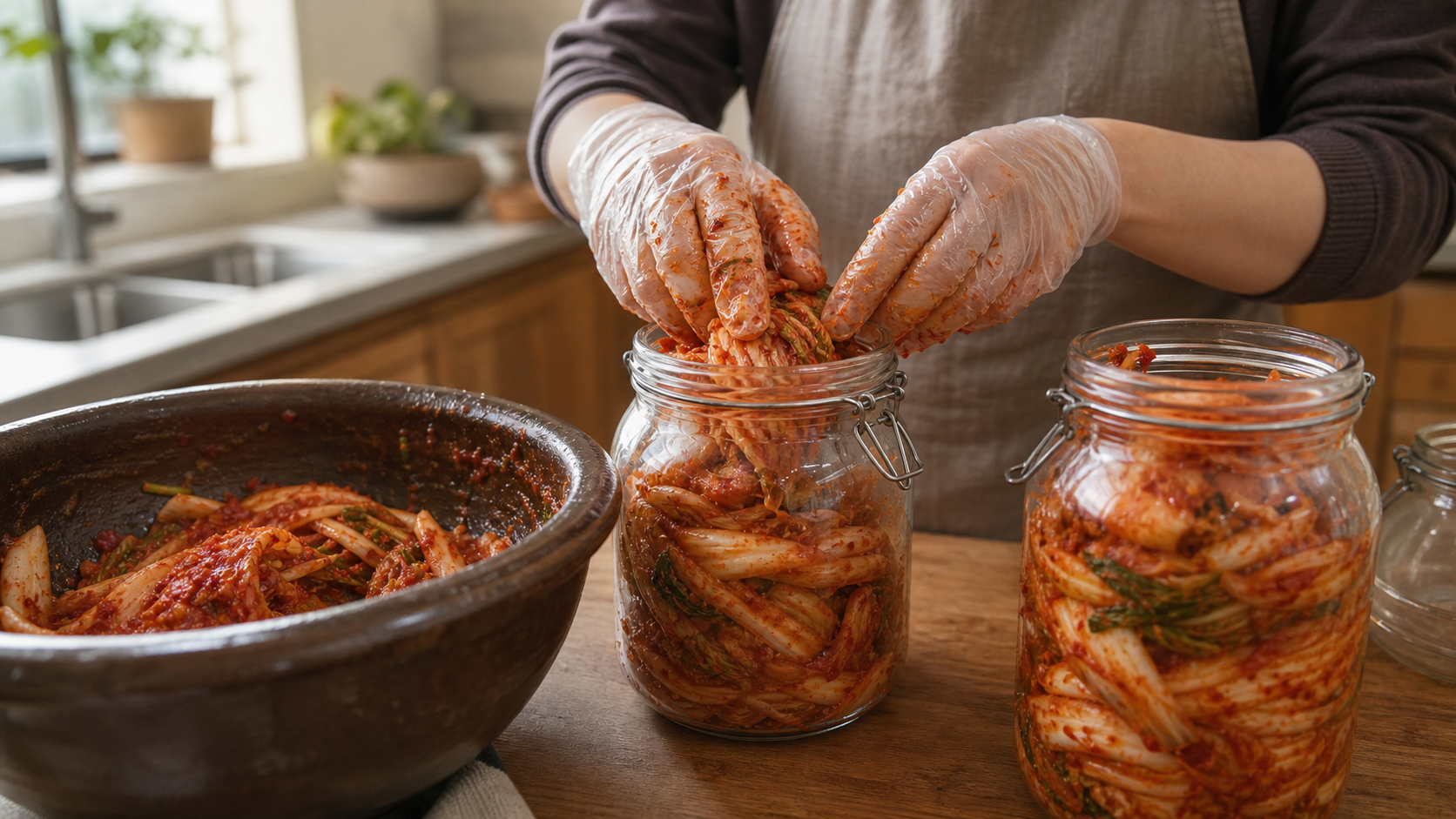
Kimchi Fermentation: The Salt, Temperature & Time Math (2026)
Osmosis, selective pressure, Q₁₀ rate curves, and pH — the food science behind every jar
Kimchi recipes hand you measurements. The food science hands you understanding — and once you have it, you can adapt any recipe confidently, diagnose a batch gone wrong, and know exactly what you are asking the microbes to do. This article unpacks the three core variables: salt concentration, temperature, and time — with the math that connects them.
The numbers here come from established food microbiology and widely cited Korean fermentation research. Where exact values depend on batch composition, vegetable water content, or microbial load, this is noted explicitly as approximate. Nothing is fabricated.
Salt and Osmosis — Why 2–3% Is Not Arbitrary
A salinity of 2–3% by total weight is the standard target for kimchi because it selectively favors lactic acid bacteria (LAB) while suppressing most spoilage organisms. Below about 1.5%, gram-negative spoilage bacteria survive and can outcompete LAB. Above about 5%, even salt-tolerant LAB are inhibited and fermentation stalls. The 2–3% range is a biological selectivity window, not just a flavor preference.
The mechanism is osmosis. When salt contacts napa cabbage, water inside the plant cells migrates outward across the semi-permeable cell membrane to equalize solute concentration — the same thermodynamic principle that governs all osmotic processes. This water-loss step is not optional: it softens the cabbage texture, concentrates the natural sugars and nutrients inside the cells, and creates the liquid brine that LAB will inhabit.
Salt also acts as what food scientists call a selective pressure. Most spoilage bacteria — particularly gram-negative organisms like coliform species — are sensitive to elevated sodium concentrations. The dominant kimchi LAB, primarily Leuconostoc mesenteroides and Lactobacillus plantarum, are halotolerant: they survive and thrive in the 2–3% brine environment where competitors cannot. The salt does not kill spoilage organisms directly; it simply removes their competitive advantage, allowing LAB to dominate.
| Salinity % | Effect on Microbiome | Outcome for the Batch |
|---|---|---|
| <1.5% | Spoilage bacteria survive; LAB cannot outcompete | Risk Off-flavors, sliminess, rot |
| 1.5–2% | Marginal selectivity; LAB disadvantaged | Caution Unpredictable; needs strict temperature control |
| 2–3% | Optimal selective pressure; LAB dominant | Target Correct fermentation, balanced flavor |
| 3–5% | LAB activity slows; overall microbial load low | Caution Under-fermented, salt-forward taste |
| >5% | LAB substantially inhibited | Risk Minimal fermentation; very salty product |
Target salinity: 2.5% of total weight. You will use approximately 400 g water as initial brine.
A simpler approximation: use 2–2.5% of the cabbage weight as a starting point. For 1 kg cabbage, that is 20–25 g salt. The total-weight formula above is more precise; the simpler estimate is accurate enough for home batches where exact water addition varies.
The Temperature–Time Curve
Fermentation rate roughly doubles for every 10°C increase in temperature — a well-established food microbiology principle known as the Q₁₀ factor (approximate Q₁₀ of 2–3 for LAB). In practice: at 20–22°C (cool room temperature), kimchi typically reaches peak flavor in 2–4 days. At 4°C (standard refrigerator), the same process takes approximately 3–6 weeks. Temperature is the primary dial for controlling fermentation speed.
The Q₁₀ principle (also written Q10) describes how biological reaction rates change with temperature. For lactic acid fermentation, the relationship is approximately:
All times approximate. Actual duration depends on salt %, initial bacterial load, vegetable water content, and jar fill level. "Peak flavor" is subjective; sour preference varies.
| Temperature Range | Approx. Days to Peak | Practical Notes |
|---|---|---|
| 25–28°C (warm room / summer) | 1–2 days | Very fast; easy to over-ferment. Check daily, refrigerate early. |
| 18–22°C (cool room / spring-autumn) | 2–4 days | Standard room-temp method. Most reliable for beginners. |
| 10–15°C (cellar / kimchi fridge) | 1–2 weeks | Slower process produces more complex flavor. Traditional onggi pot method. |
| 2–5°C (standard refrigerator) | 3–6 weeks | Very slow; suitable for long-term preservation. Flavor deepens over months. |
The standard home practice of brief room-temperature fermentation followed by refrigeration is thermodynamically deliberate. The initial warm period (1–2 days at 18–22°C) allows LAB to establish dominance and produce enough lactic acid to drop pH quickly. Moving to the refrigerator then slows the reaction dramatically, extending the flavor window from days to weeks. This two-phase approach exploits the temperature-rate relationship intentionally.
pH as the Progress Signal
Fresh kimchi starts at approximately pH 6.0–6.5 (mildly acidic, close to neutral). As LAB produce lactic acid, pH drops steadily. Well-fermented kimchi at peak flavor typically measures pH 4.2–4.6. Below pH 4.0, kimchi is generally considered over-sour — the texture begins to soften excessively and the sharp acidity overpowers other flavors. These are approximate values that vary by batch; the directional trend is consistent.
pH is a logarithmic scale: pH 4 is ten times more acidic than pH 5. A drop from pH 6.5 to pH 4.5 represents a roughly 100-fold increase in hydrogen ion concentration — which explains why the transition from fresh to fermented kimchi is perceptually dramatic even though the absolute pH change is only two units.
Approximate values; vary by recipe, salt %, temperature, and ingredient composition. Home pH strips (range 3–7) are sufficient for monitoring batches.
Two Phases of Microbial Succession
Kimchi fermentation proceeds through two largely sequential microbial phases, each driven by a different LAB species:
- Phase 1 — Leuconostoc mesenteroides: Dominates the early days of fermentation (approximately pH 6.0 down to pH 5.0). Produces CO2 along with lactic acid, which purges oxygen from the jar and creates the anaerobic environment that Phase 2 bacteria need. Leuconostoc is less acid-tolerant — once pH drops below about 4.5, its activity diminishes.
- Phase 2 — Lactobacillus plantarum: Thrives in the more acidic, anaerobic conditions established by Phase 1. Continues acid production, driving pH toward the 4.0–4.5 range. More acid-tolerant than Leuconostoc, so it dominates the later and longer portion of fermentation. Over-fermentation is largely Lactobacillus-driven.
This succession is why kimchi flavor complexity deepens over time: the two-phase chemistry produces a wider array of organic acids, esters, and CO2 than either organism alone would generate.
Worked Examples — Calculating for Your Batch
To find your salt quantity: multiply the total weight of cabbage plus estimated brine water by 0.02 to 0.025. For a 1 kg cabbage batch with 400 g water, that gives approximately 28–35 g salt. To plan your fermentation timeline: pick your target temperature from the table above and add 50% buffer time (batches vary). Refrigerate immediately when sourness level is right, not on a fixed calendar day.
The key distinction: salt quantity determines who ferments (LAB selectivity); temperature determines how fast (Q10 scaling); time is the integrated outcome of both. Changing any one variable shifts the other two in a predictable direction. This is why a recipe that works perfectly in a cool Korean autumn kitchen may over-ferment in a warm apartment or stall in an air-conditioned summer room at 18°C.
Target salinity: 2.5%. Brine water: approximately 1 kg. Room temperature: 20°C.
At 20°C, expect fermentation to reach peak in approximately 2–4 days (taste-check from day 2). Refrigerate at your preferred sourness. The large batch will continue to slowly acidify in the refrigerator — factor this in if you want it mild long-term.
Same quantities as Example B. Transferred directly to refrigerator (4°C) after packing.
LAB reaction rate is approximately one-third of the room-temperature rate. If room-temp fermentation takes 3 days, the fridge method takes approximately 3 ÷ 0.33 ≈ 9 days, consistent with the 3–6 week observed range at 4°C. The slower rate produces finer flavor development. Note: the Q₁₀ estimate here is approximate; bacterial strain variation and salt concentration shift the exact value.
If you are interested in how ratio math works for other kitchen staples, the same underlying logic applies to rice-to-water ratio (which is not linear) and to coffee extraction math — both governed by absorption capacity, surface chemistry, and temperature.
What Goes Wrong — and Why the Math Predicts It
Most kimchi failures fall into four predictable categories, each traceable to a specific variable being out of range: too little salt (spoilage wins), too much salt (LAB inhibited), too warm (over-ferments in hours), too cold (fermentation stalls for weeks). Understanding the mechanism tells you not just what went wrong, but what to change on the next batch.
Over-sour kimchi (pH below 4.0) is not a microbial accident — it is the predictable result of adequate LAB at adequate temperature for too long without refrigeration. The bacteria did exactly what they were supposed to do; the fermentation window was simply not closed in time. Conversely, kimchi that never develops sourness is almost always a salinity problem (too high, inhibiting LAB) or a temperature problem (too cold, stalling kinetics).
| Symptom | Likely Cause | Mechanism | Fix / Prevention |
|---|---|---|---|
| Slimy texture, off-smell | Salinity < 1.5% | Spoilage bacteria survive; produce proteases that break down cabbage structure | Discard. Restart with verified salt weight. Weigh, do not estimate. |
| No sourness after 5+ days at room temp | Salinity > 4% or temperature < 10°C | LAB inhibited (high salt) or kinetics too slow (cold) | Check salt calculation; move to warmer location (18–22°C) |
| Over-sour within 24 hours | Temperature > 28°C | Q₁₀ scaling: LAB rate too high at warm temps | Refrigerate immediately. In future: ferment in cooler space or for shorter window |
| Mushy, falling-apart texture | Over-fermented (pH < 4.0) or initial salinity too low | Excess acid degrades pectin in cell walls; low salt allows softening proteases | Use in kimchi jjigae or pancakes (cooking heat neutralizes sharpness) |
| Surface mold / white film | Aerobic conditions (brine not covering vegetables) | Oxygen enables yeast / mold growth above the brine line | Keep vegetables submerged under brine at all times. Press down daily. |
Frequently Asked Questions
How much salt do I use for kimchi?
The target is 2–3% salinity by total weight (cabbage + water + salt). A practical home approximation: use 2–2.5% of the cabbage weight as salt. For 1 kg of napa cabbage, that is 20–25 g of salt (approximately 1.5–2 teaspoons of coarse sea salt, though weight measurement is more reliable than volume). This range selects for lactic acid bacteria while inhibiting most spoilage organisms through osmotic selective pressure. Going significantly below 1.5% risks spoilage; above 5% inhibits the beneficial bacteria you need for fermentation.
How long does kimchi take to ferment?
Fermentation time depends primarily on temperature. At 18–22°C (room temperature), kimchi typically reaches good sourness in 2–4 days. At 25–28°C (warm room or summer), it may be ready in 1–2 days — check daily. At refrigerator temperature (2–5°C), the same process takes approximately 3–6 weeks. These are approximate ranges; actual time varies by salt percentage, vegetable water content, and personal sourness preference. The LAB fermentation rate roughly doubles for every 10°C increase in temperature (Q₁₀ principle).
What is the ideal pH for kimchi?
Freshly made kimchi starts at approximately pH 6.0–6.5. The target fermented range considered optimal for flavor is approximately pH 4.2–4.6 — tangy, balanced, with the main desirable organic acids fully developed. Below pH 4.0, kimchi is generally considered over-sour: the acidity becomes sharp and the cabbage texture softens excessively. These are approximate values that vary by recipe and ingredient composition. Home pH strips (3.0–7.0 range) are sufficient for practical monitoring.
Why does kimchi get sour faster at room temperature?
Because lactic acid bacteria (LAB) metabolic rate increases significantly with temperature, following a relationship described in food microbiology as the Q₁₀ factor — approximately, the rate doubles every 10°C. At 20°C versus 4°C, LAB are operating at roughly 3–4 times the metabolic rate, producing lactic acid that much faster. This is why the same kimchi batch that takes 3–5 weeks in the refrigerator may reach peak sourness in 2–3 days on a kitchen counter in cool weather, or in under a day during a warm summer.
What is osmosis doing when you salt kimchi?
Salt draws water out of napa cabbage cells by osmosis: water moves from an area of low solute concentration (inside the cell) to high solute concentration (the brine around it) across the semi-permeable cell membrane, to equalize solute levels. This water migration wilts the cabbage, softens texture, concentrates natural sugars, and creates the liquid brine environment that lactic acid bacteria inhabit. The wilting step is not just about texture — it is creating the anaerobic, mineral-rich medium in which selective fermentation proceeds. Without adequate osmosis (too little salt), LAB do not have the competitive advantage they need.
Can I reduce the salt in kimchi to make it healthier?
Reducing salt below the 2% threshold significantly increases spoilage risk — the selective pressure that allows lactic acid bacteria to dominate is weakened. You can make lower-sodium kimchi (closer to 1.5–2% rather than 3%), but you should compensate with stricter temperature control (keep batches at 4°C from day one to slow all microbial activity) and shorter fermentation windows. Reducing salt to under 1.5% substantially raises the probability of spoilage regardless of temperature. Some recipes substitute partial salt with potassium chloride; this maintains osmotic effect with less sodium, though the taste profile changes slightly.
Get new posts by email
No ads. Unsubscribe anytime.
Comments
Comments (0)
Leave a Comment