Pizza Dough Hydration: The Baker's Percentage Explained (2026)
A pizza recipe that turns out to be a math lesson in disguise
Two people follow "the same" pizza dough recipe. One gets a stiff, crackery base; the other gets a sticky mess they can barely shape. Same flour, same oven, wildly different results. The reason almost always comes down to one number that home recipes rarely name out loud — and that professional bakers obsess over.
That number is hydration, and it lives inside a deceptively simple system called baker's percentage. Once you understand it, every dough recipe on the internet stops being a list of cups and spoons and starts reading like the same equation with different values plugged in. This article unpacks the math, walks through a real dough, and shows why 60%, 65%, and 70% hydration produce three genuinely different pizzas.
What Baker's Percentage Actually Is
Baker's percentage is a system where flour always equals 100%, and every other ingredient is written as a percentage of the flour's weight — not of the total. Water at 65% means 65 grams of water for every 100 grams of flour. Salt at 2.8% means 2.8 grams per 100 grams of flour. Because everything is anchored to flour, two recipes that look completely different on paper can be revealed as the same dough the moment you normalize them.
The key mental shift is that these are ratios to flour, not slices of a pie. In an ordinary percentage, the parts add up to 100. In baker's percentage they do not — and they are not supposed to. A standard pizza dough might total around 168% when you add up flour, water, salt, and yeast. That is not a mistake; flour is the reference point, and everything else is measured against it.
This is exactly the kind of normalization that shows up across food math. It is the same instinct behind a rice-to-water ratio that is not a fixed multiple — expressing one ingredient relative to another so the relationship, not the absolute amount, becomes the thing you control.
Hydration: The One Number That Controls Crumb
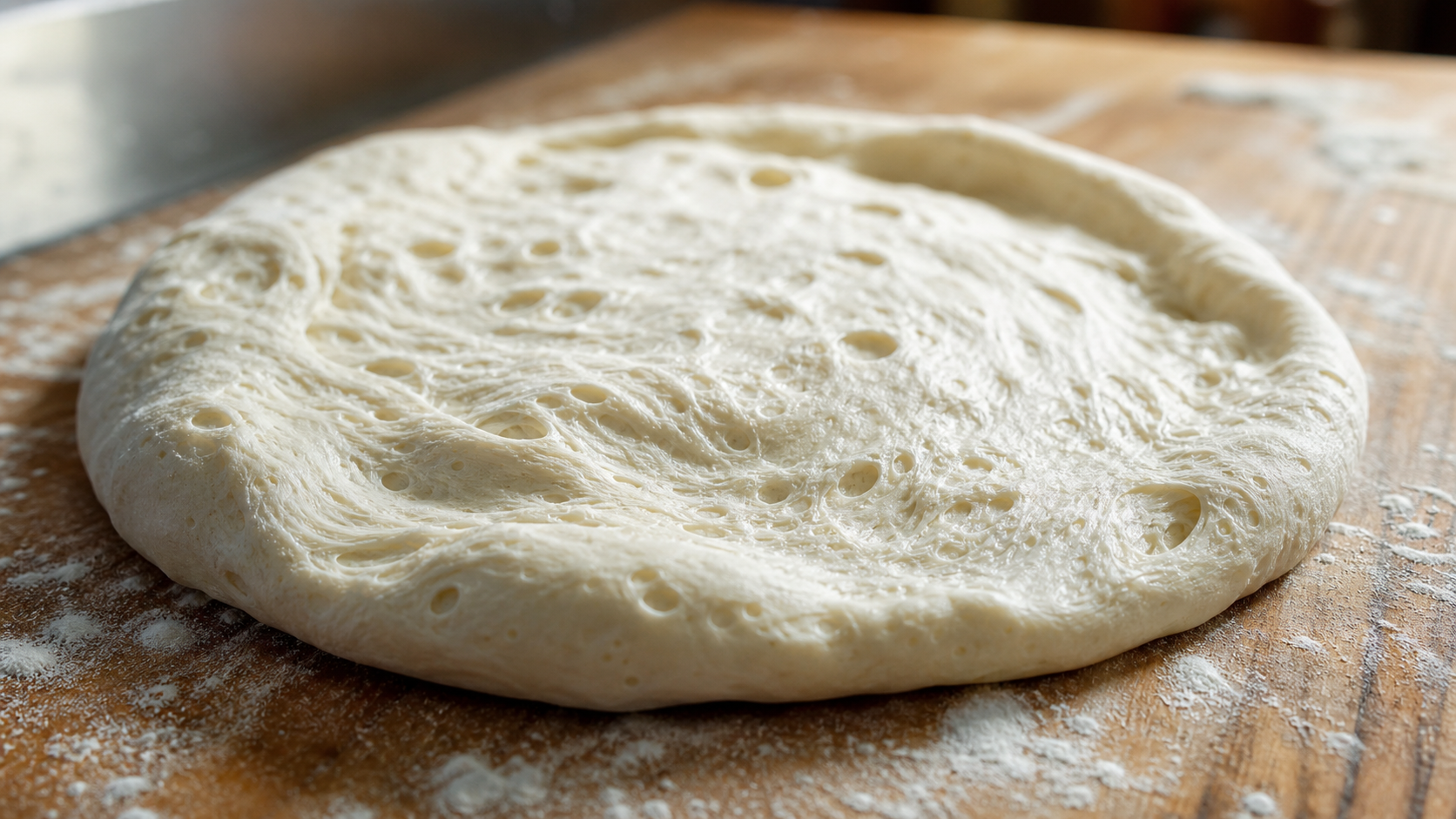
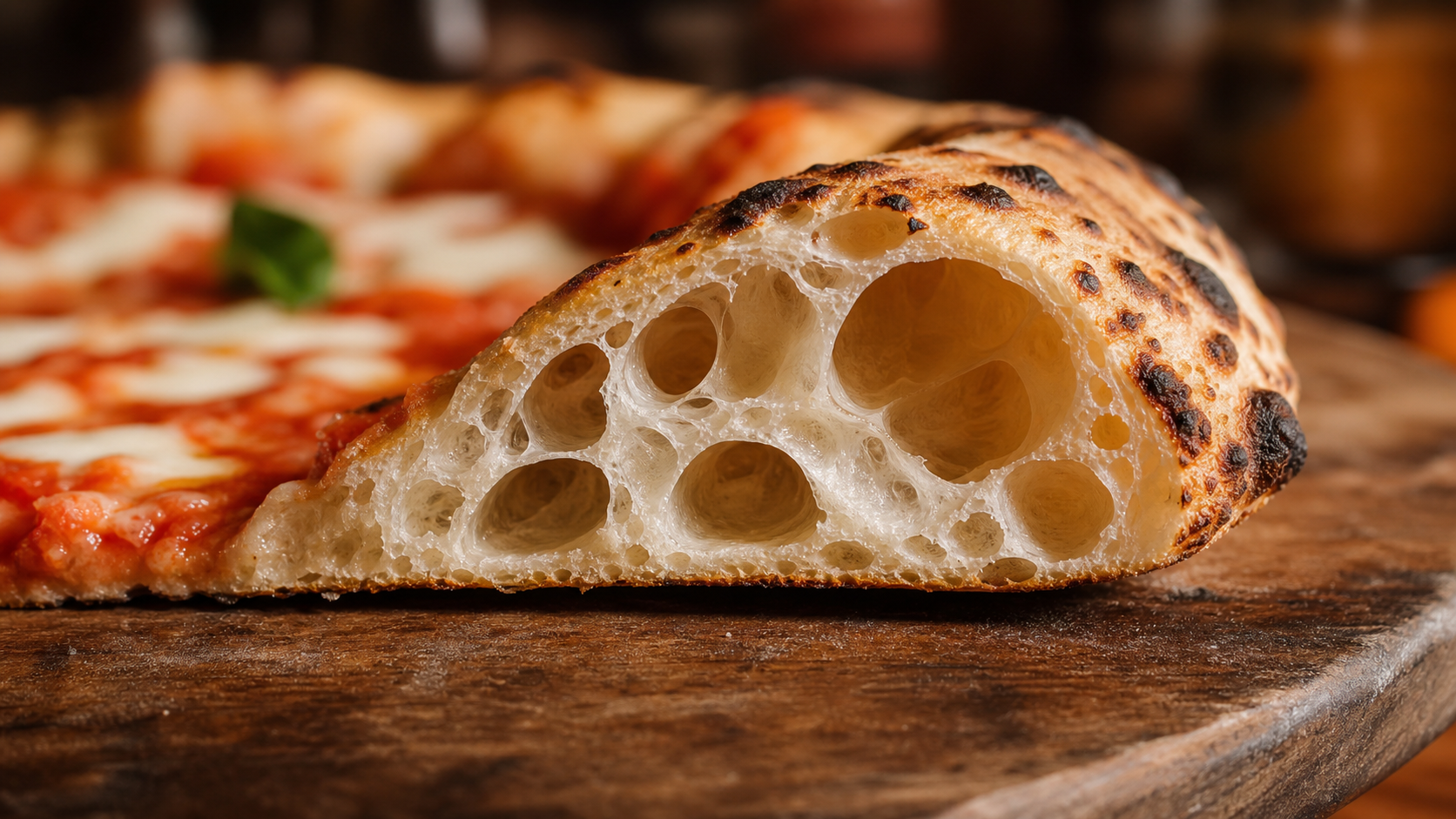
Hydration is water expressed as a percentage of flour weight — the single most important number in any bread or pizza dough. More water means a wetter, slacker dough that traps more gas and bakes into an open, airy crumb. Less water means a stiff, tight dough that is easy to handle and bakes denser and crispier. Most pizza lives between 55% and 70% hydration, and moving even a few points along that range visibly changes the finished crust.
The reason hydration matters so much is gluten. Water is what lets flour proteins link into the elastic gluten network that traps fermentation gas. Too little water and the network is stiff and under-developed; too much and it becomes so extensible that the dough slackens and spreads. Hydration is the dial that sets where on that spectrum your dough sits — which is why the same flour can become a cracker or a cloud depending on a single percentage.
These bands are craft consensus, not hard standards. Flour strength, fermentation time, and oven temperature all shift where each range performs best.
One practical truth worth internalizing: higher hydration is not automatically "better." A wetter dough can give a more open crumb, but it is also harder to shape, harder to launch into the oven, and far less forgiving. The right hydration is the one matched to your flour, your skill, and your oven — not the highest number you can find online.
A Real Dough, Worked Out at 65% Hydration
To turn percentages into grams, pick a flour weight and multiply each percentage by it. For a 65% hydration dough built on 1000 g of flour: water is 1000 × 0.65 = 650 g, salt at 2.8% is 28 g, and yeast at 0.3% is 3 g. That is enough dough for roughly four 280–290 g pizza balls. Change the flour weight and every other ingredient scales with it automatically — that is the entire point of the system.
Here is the same dough written both ways — as a formula (percentages) and as a batch (grams). The formula is portable; the grams are just one instance of it.
| Ingredient | Baker's % | Grams (1000 g flour) | Role |
|---|---|---|---|
| Flour (00 or bread flour) | 100% | 1000 g | The reference; provides gluten |
| Water | 65% | 650 g | hydration sets crumb & handling |
| Salt | 2.8% | 28 g | Flavor; tightens gluten; slows yeast |
| Fresh yeast | 0.3% | 3 g | Fermentation (use ~0.1% instant dry) |
| Total formula | 168.1% (over 100% — and that is correct) | ||
You only want 3 pizzas, about 850 g of flour. Keep the same formula:
No re-guessing, no "a bit less water." The percentages stay fixed; only the flour weight changes.
This is also where an AI assistant becomes genuinely useful — not for inventing a recipe, but for doing the arithmetic instantly once you give it the formula. The math never changes; only the flour weight does.
(Role) You are a baking assistant. (Context) I use baker's percentage: water 65%, salt 2.8%, instant yeast 0.1%. (Task) Give me the grams for [700 g] of flour. (Format) A short table with one row per ingredient.
For 700 g flour at your formula:
Flour: 700 g · Water: 700 × 0.65 = 455 g
Salt: 700 × 0.028 = 19.6 g · Yeast: 700 × 0.001 = 0.7 g
That yields ~1175 g of dough, roughly four 290 g balls.
60% vs 65% vs 70% — How Hydration Changes the Pizza
Within the everyday pizza range, three points of hydration are clearly different doughs. At 60%, the dough is firm, rolls out easily, and bakes into a crisp, tight-crumbed base — close to New York and Roman styles. At 65%, it becomes softer and more extensible with a more open rim. At 70%, the dough is noticeably wet and sticky, capable of a very airy, blistered Neapolitan-style cornicione, but demanding skill and a very hot oven to handle and bake well.
The trade-off running through the whole range is openness versus control. More water buys you a lighter, airier crumb, but it costs handling ease and forgiveness. Less water gives you a dough you can shape confidently every time, at the price of a denser, crisper result. Neither is "better" in the abstract — they are different targets.
| Hydration | Handling | Crumb & crust | Best for |
|---|---|---|---|
| 60% | Firm, easy to roll | Tight, crisp, sturdy | beginner NY / Roman / cracker-style |
| 65% | Soft, slightly tacky | Balanced, light, foldable | all-round everyday home pizza |
| 70% | Wet, sticky, slack | Very open, airy, blistered | advanced Neapolitan, very hot oven |
If your dough behaves badly, the fix is usually a small hydration adjustment, not a new recipe. Too slack and unmanageable? Drop two or three points. Too stiff and tearing when you stretch it? Add two or three. Because the system is just arithmetic, these corrections are precise and repeatable instead of guesswork.
Why Pros Use Percentages Instead of Recipes
Professional bakers think in baker's percentage because it solves three problems a fixed recipe cannot: scaling, comparing, and diagnosing. Scaling is automatic — change the flour weight and every ingredient follows. Comparing is trivial — normalize any two recipes to flour and you can see instantly which is wetter or saltier. Diagnosing is precise — a flaw maps to a specific percentage you can nudge by a known amount, rather than vaguely "adding a little more water."
A printed recipe is a single frozen snapshot — it works for exactly one batch size and tells you nothing about how to adjust it. A formula in percentages is the underlying function that generated that snapshot. Once you hold the function, you can produce any batch size, port the dough to a different flour, or troubleshoot it on the fly. The recipe is the output; the percentage is the rule.
This is the same shift that separates following instructions from understanding a system. It shows up wherever a process is governed by ratios rather than fixed amounts — in the salt and temperature math behind kimchi fermentation, or in the sugar-glass science of why dalgona cracks. In each case, naming the ratio is what turns a fragile recipe into something you can actually control and repeat.
Frequently Asked Questions
What is baker's percentage?
Baker's percentage is a system used in professional baking where flour always equals 100%, and every other ingredient is expressed as a percentage of the flour's weight rather than of the total recipe. Water at 65% means 65 grams of water per 100 grams of flour; salt at 2.8% means 2.8 grams per 100 grams of flour. Because everything is anchored to flour, recipes scale and compare cleanly. It only works with weights in grams, not volume measures.
What hydration should pizza dough be?
Most pizza dough falls between 55% and 70% hydration. Around 60% gives a firm, easy-to-handle dough with a crisp, tight crumb (New York and Roman styles). Around 65% is a balanced all-rounder for home baking. Around 70% produces a very open, airy crumb in the Neapolitan style but is sticky and demands a very hot oven and good technique. Beginners are usually best starting near 62–65%, where the dough is forgiving but still light.
How do I calculate the water for pizza dough?
Multiply the flour weight by the hydration percentage: water (g) = flour (g) × hydration%. For 1000 g of flour at 65% hydration, that is 1000 × 0.65 = 650 g of water. The same approach gives every other ingredient — salt at 2.8% of 1000 g is 28 g, and so on. Pick your flour weight first, then everything else follows from its percentage.
Why is my pizza dough too sticky or too dry?
Stickiness usually means the hydration is too high for your flour or your skill level — try dropping two or three percentage points (for example from 68% to 65%). A dough that is stiff, tears when stretched, or feels dry usually needs the opposite: add two or three points of water. Flour also matters, because stronger, higher-protein flours absorb more water, so the same percentage can feel wetter or drier depending on the flour you use.
Can baker's percentage add up to more than 100%?
Yes, and it almost always does. Baker's percentages are ratios to flour, not slices of a whole, so they are not required to sum to 100%. A typical pizza dough totals around 165–170% once you add flour (100%), water (about 65%), salt (about 2.8%), and yeast. A total above 100% is completely normal and expected — it simply reflects that flour is the reference point, not the entire recipe.
What is the hydration difference between Neapolitan and New York pizza dough?
New York style typically sits around 60–63% hydration, producing a sturdy, foldable slice with a crisp underside. Authentic Neapolitan dough, per the AVPN standard, runs roughly in the high 50s to low 60s percent but is paired with finely milled 00 flour and a 430–480°C oven, which together create its signature airy, blistered cornicione. The airiness comes from flour strength and extreme oven heat as much as from water content, which is why simply raising hydration at home rarely reproduces it.
Get new posts by email
No ads. Unsubscribe anytime.
Comments
Comments (0)
Leave a Comment