Why Dalgona Cracks: The Science of Sugar Glass (2026)
Baking soda chemistry, amorphous solids, and brittle fracture — explained from first principles
Every dalgona maker knows the candy shatters. Most have no idea why. The answer turns out to involve a chemical decomposition reaction, a class of materials called amorphous glasses, and a fracture mechanism that engineers study in ceramics and optical fibers. None of it is complicated once you see the steps in sequence.
This article works through the full causal chain: what baking soda actually does inside molten sugar, why rapid cooling traps that sugar in a glassy rather than crystalline state, what makes amorphous glasses brittle, and how the amount of baking soda directly controls how easily your dalgona cracks. Along the way, it addresses the Squid Game ppopgi challenge — because that challenge is a nearly perfect practical demonstration of brittle fracture mechanics. No recipe here. Pure science, from the molecules up.
What Happens When You Add Baking Soda to Molten Sugar
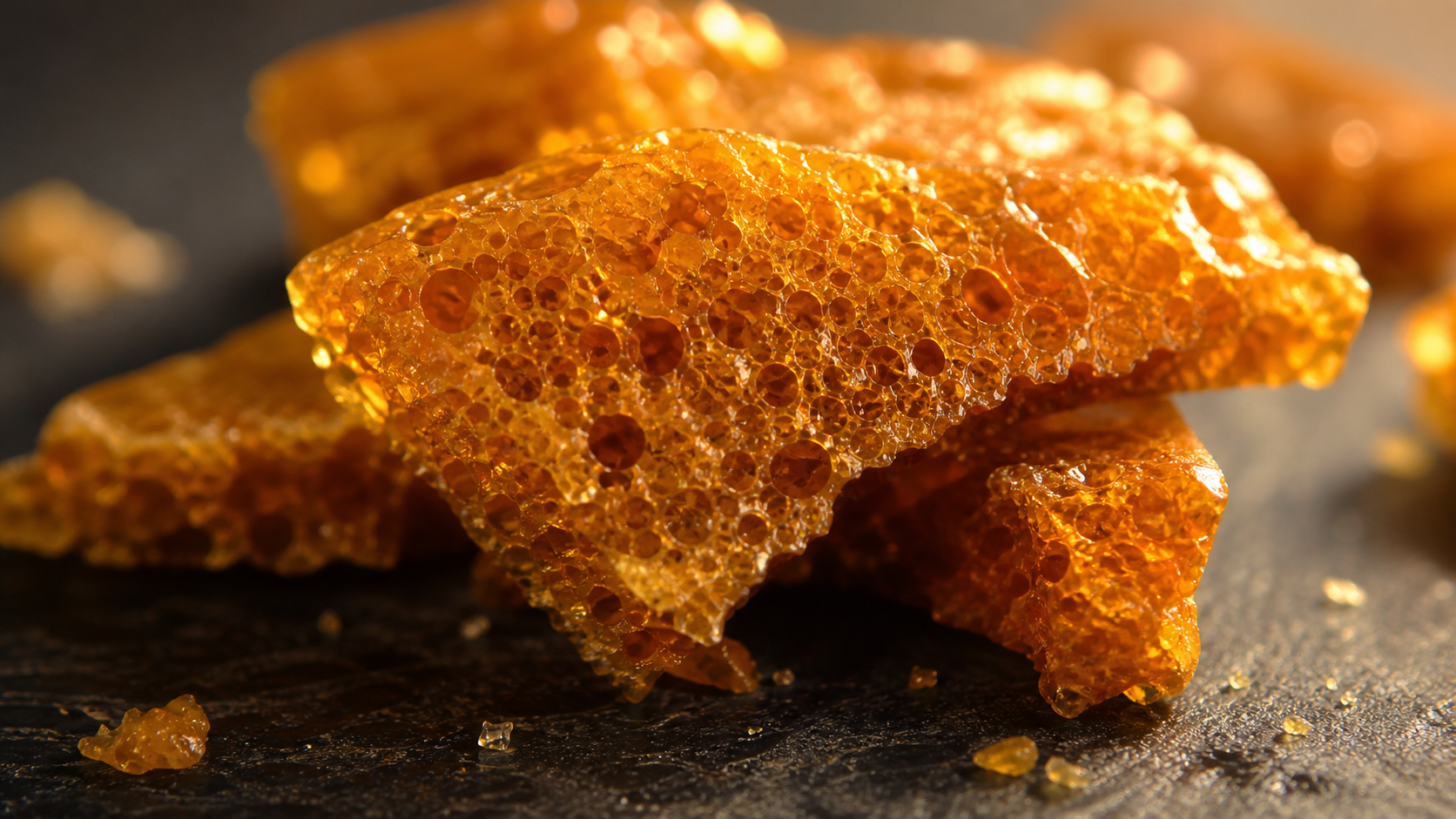
When sodium bicarbonate (baking soda, NaHCO₃) is added to molten sugar at around 160–180°C, it decomposes into sodium carbonate, water vapor, and carbon dioxide gas. The CO₂ cannot escape through the highly viscous sugar melt, so it inflates as bubbles that are locked in place when the candy cools. That trapped gas network is the honeycomb structure of dalgona, and it is entirely the product of one balanced chemical reaction.
The balanced decomposition equation is:
Baking soda begins to decompose noticeably above about 50°C and the reaction becomes rapid above 80°C. Since molten sugar for dalgona is already at 160–180°C, decomposition happens almost instantly once the baking soda is added. The key variable is viscosity: the sugar melt at this temperature is thick enough to trap the CO₂ gas rather than letting it bubble away freely, as it would in water.
Sodium carbonate (Na₂CO₃) remains in the candy after cooling. It is a mild alkali and contributes a faintly alkaline, slightly bitter-soda aftertaste that distinguishes dalgona from plain caramel. If you have ever noticed that dalgona tastes subtly different from burnt sugar, that is why.
Step-by-Step: What Happens in the Pan
Step 1. Sugar (sucrose, C₁₂H₂₂O₁₁) melts at ~160°C. The melt is clear, highly viscous, and contains no gas.
Step 2. Baking soda is added. Decomposition begins immediately: 2 NaHCO₃ → Na₂CO₃ + H₂O + CO₂. The melt begins to foam and expand — volume can triple or quadruple.
Step 3. The mixture is poured onto a cool surface and pressed flat. Pressing sets the shape and compresses large bubbles into the fine honeycomb texture.
Step 4. As the candy cools below ~67°C (the glass transition temperature of amorphous sucrose), the sugar matrix solidifies around the trapped CO₂ bubbles, permanently locking in the porous structure.
Why Sugar Becomes Glass, Not Candy
When sugar is melted and then cooled rapidly, its molecules do not have enough time to return to an organized crystal lattice. Instead, they freeze in a disordered arrangement — an amorphous solid, which materials scientists classify as a glass. This is what gives dalgona its transparency, its hardness at room temperature, and crucially, its brittleness. The same physics that makes window glass shatter rather than bend applies to sugar glass at room temperature.
In everyday use, "glass" refers to windows. In materials science, it refers to any amorphous (non-crystalline) solid. The defining characteristic is not composition but structure: the atoms or molecules are arranged without long-range order, as in a liquid, but they are immobile, as in a solid. Sugar glass and silicate window glass obey the same structural classification — they just differ in composition and in the temperature range where their glassy behavior occurs.
| Property | Crystalline sugar (e.g., rock candy, fondant) | Amorphous sugar glass (dalgona, hard candy) |
|---|---|---|
| Molecular arrangement | Regular, repeating lattice | Disordered, frozen-liquid arrangement |
| Appearance | Opaque, grainy, or powdery | Transparent to translucent, glassy sheen |
| Texture at room temp. | Grainy, dissolves with a gritty feel | Hard, brittle, shatters under stress |
| On heating | Sharp melting point (~185°C for sucrose) | Gradual softening from glass transition temp. (~67°C dry) |
| Moisture sensitivity | Dissolves in water; less hygroscopic | Highly hygroscopic — absorbs moisture, softens, becomes sticky |
| Fracture behavior | Crumbles along crystal planes | Brittle fracture — clean crack propagation |
| How it forms | Slow cooling, seeded crystallization | Rapid cooling, no nucleation sites |
The Glass Transition Temperature (Tg)
Every amorphous solid has a glass transition temperature (Tg) — a range below which the material behaves as a rigid glass and above which it becomes a rubbery, viscous supercooled liquid. For dry amorphous sucrose, Tg is approximately 67°C (about 153°F). (Source: Roos, 1993, Carbohydrate Research.) At typical room temperature (20–25°C), dalgona is approximately 42–47°C below its Tg, placing it firmly in the brittle glassy regime.
How Much Baking Soda — and Why It Changes Everything
The ratio of baking soda to sugar directly controls three interconnected properties: porosity (how many bubbles form), wall thickness (how much solid sugar remains between bubbles), and brittleness (how easily those walls crack under stress). Traditional dalgona uses roughly 1 part baking soda to 12 parts sugar by mass. Using more soda creates more CO₂, thinner sugar walls, and a candy that cracks at the slightest touch — or even spontaneously. Using too little gives a dense, nearly bubble-free disk that is very hard to crack cleanly.
This is not a recipe preference. It is material engineering. By adjusting the soda-to-sugar ratio, the maker is tuning the mechanical properties of the candy as deliberately as an engineer adjusts alloy composition to control metal hardness. The Squid Game ppopgi challenge implicitly exploits this: a candy with a lower soda ratio (denser, thicker walls) is significantly harder to cut with a needle without cracking, which is why it is used as a game mechanic.
| Baking Soda Amount | Porosity | Wall Thickness | Cracking Behavior | Flavor Note |
|---|---|---|---|---|
| Low (<1:20 soda:sugar by mass) | Low — few bubbles | Thick, dense walls | Requires significant force; harder to crack cleanly | Clean caramel; no soda aftertaste |
| Standard (~1:12 soda:sugar by mass) | Medium — visible honeycomb | Moderate walls | Ideal snap — clean break with firm press or needle | Slight alkaline note; classic dalgona flavor |
| High (>1:6 soda:sugar by mass) | Very high — large, irregular bubbles | Very thin, fragile walls | Cracks spontaneously; crumbles rather than snapping | Strong soda/bitter aftertaste |
A Visual Model: How Porosity Affects Wall Strength
The diagram below represents the internal cross-section of dalgona at three soda levels. Amber circles are sugar walls; gray circles represent voids (CO₂ bubbles). The higher the porosity, the thinner the load-bearing walls, and the lower the stress required to initiate a crack.
The Physics of the Crack: Brittle Fracture Explained
Brittle fracture happens when a material fails by propagating a crack rather than by deforming plastically (bending or stretching). In amorphous glasses like sugar glass, there are no ordered planes of atoms that can slide past one another to absorb mechanical energy — so when stress at any point exceeds local bond strength, a crack initiates and propagates rapidly. The crack follows the path of lowest fracture energy, which in porous dalgona means along the thinnest sugar walls. Pressing a shape into the candy concentrates stress precisely where the sugar layer is thinnest — which is why the candy can be cut at the outline of the pressed shape if done carefully and slowly.
Brittle vs. Ductile Fracture
The distinction between how different materials break is fundamental to materials science:
- Ductile materials (metals, rubber, soft plastics): under stress, atomic bonds reorganize. Atoms slide past each other in a process called plastic deformation. Energy is absorbed by that deformation. The material bends, stretches, or necks before breaking. Failure is preceded by visible shape change.
- Brittle materials (glass, ceramics, amorphous solids): no organized slip planes exist. When stress at a defect or stress concentration exceeds the local cohesion energy, a crack initiates. The elastic energy stored in the stressed material drives crack propagation — rapidly, with no prior warning deformation. The fracture surface is typically smooth and flat.
Sugar glass falls squarely in the brittle category. Its amorphous molecular arrangement means there are no crystal slip systems. Stress cannot be redistributed by deformation; it can only be released by cracking.
Stress Concentration and the Ppopgi Challenge
When you press a shape mold into dalgona, the pressed groove creates a region of reduced thickness in the candy. Mechanically, any abrupt change in cross-section concentrates stress — a classic stress concentration factor, well known in structural engineering. The stress concentration at the bottom of the groove means a crack requires less applied force to initiate there than anywhere else in the candy.
In the Squid Game ppopgi challenge, the goal is to separate the shape without cracking it. The optimal technique — slowly melting the candy edge with body heat from a thumb or the flat of a needle, rather than applying direct mechanical force — works because it temporarily raises the local temperature above the glass transition temperature, allowing the thin sugar layer to flow and separate without the crack propagating into the shape itself. This is not cheating; it is a direct application of Tg science.
Why the Crack Runs Along the Pressed Shape
Three factors combine to guide the crack along the pressed boundary rather than randomly through the candy:
- Reduced wall thickness at the groove: less material means less fracture energy required
- Stress concentration at the groove edge: the abrupt geometry multiplies local stress
- Porosity gradient: pressing compresses the local bubble structure, locally increasing density and creating a microstructural discontinuity that acts as a preferred fracture path
All three effects steer the crack toward the pressed line, making the clean separation of the shape physically possible — if the candy's porosity (baking soda level) is in the right range, and if stress is applied slowly enough to avoid simultaneous crack initiation at other points.
Frequently Asked Questions
Why does dalgona crack when you press on it?
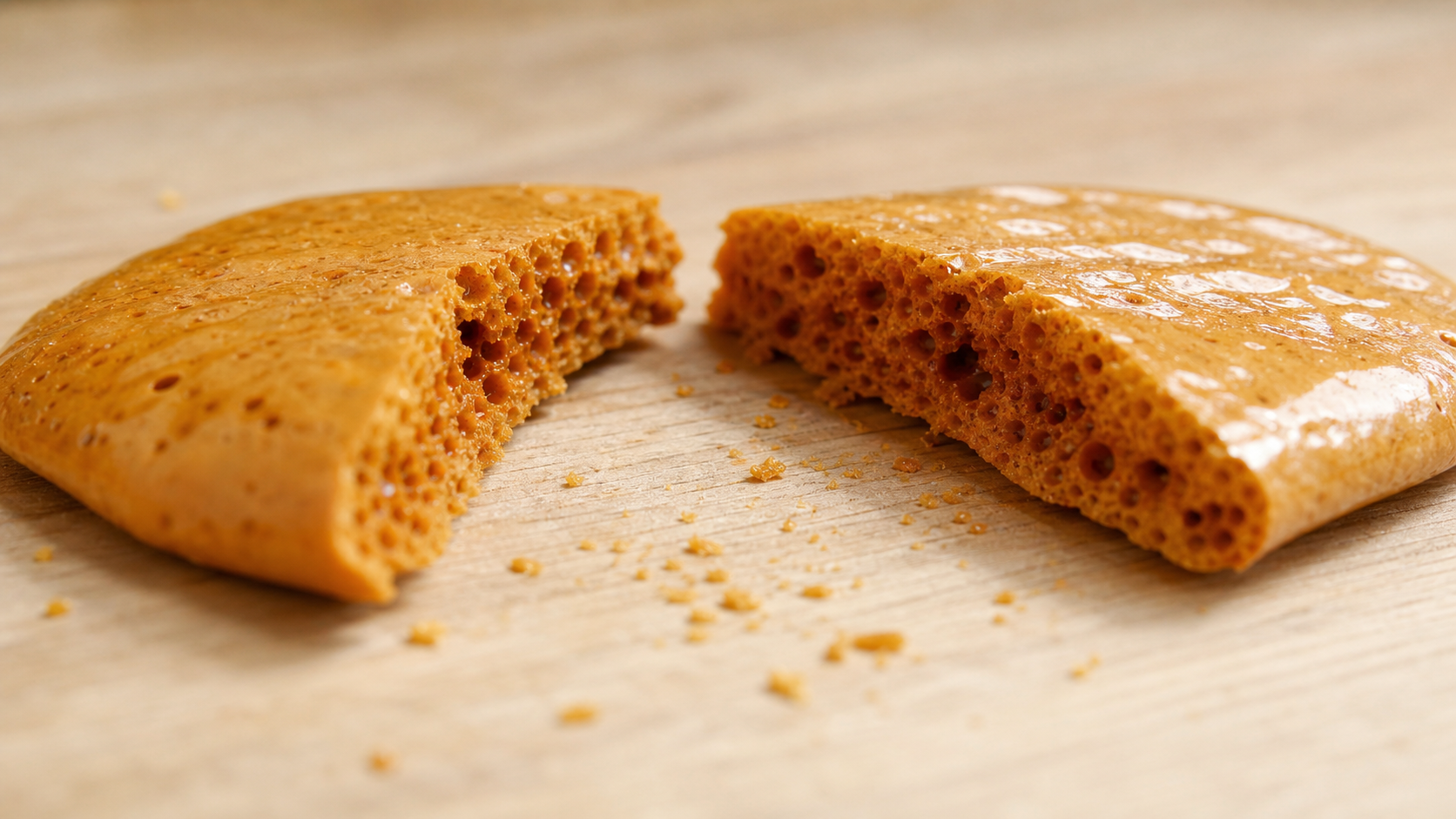
Dalgona cracks because it is an amorphous glass — a disordered solid with no slip planes for plastic deformation. When stress is applied, it cannot be absorbed by atomic rearrangement, so it is released by initiating and propagating a crack. The crack tends to follow the pressed groove or the thinnest wall, because those are the points of highest stress concentration and lowest fracture energy. The baking soda bubbles inside the candy make the walls thinner and more uniformly brittle, which is what allows the candy to crack in a controlled, predictable way along a pressed shape rather than shattering randomly.
What does baking soda do to dalgona?
Baking soda (sodium bicarbonate, NaHCO₃) decomposes in the heat of molten sugar: 2 NaHCO₃ → Na₂CO₃ + H₂O + CO₂. The carbon dioxide gas produced cannot escape through the thick sugar melt, so it inflates as bubbles that are locked in place when the candy cools. Those bubbles are the honeycomb texture of dalgona. Without baking soda, heated sugar would simply caramelize into a dense, glassy disk with no internal structure and no meaningful crack-guiding geometry.
What is amorphous sugar glass?
Amorphous sugar glass is what forms when sucrose is melted and then cooled faster than the molecules can re-organize into a crystal lattice. Instead of returning to an ordered crystalline structure (as in powdered sugar or rock candy), the molecules freeze in a random arrangement — the same structural definition as a glass. Amorphous sucrose glass has a glass transition temperature of approximately 67°C (dry). At room temperature it is hard, transparent, and brittle. Absorbed moisture lowers the glass transition temperature, which is why dalgona softens and becomes sticky in humid conditions.
How does the amount of baking soda affect how dalgona breaks?
More baking soda means more CO₂ production, more bubbles, higher porosity, and thinner sugar walls between bubbles. Thinner walls require less force to crack. A candy made with too much baking soda (above roughly 1 part soda to 6 parts sugar by mass) has walls so thin that it crumbles rather than snapping cleanly. Too little soda (below about 1:20 by mass) produces a dense candy with thick walls that requires significant mechanical force to crack and does not break cleanly along a pressed shape. The traditional ratio of roughly 1:12 is a practical optimum for the combination of clean cracking behavior and acceptable flavor.
Why does dalgona go soft and sticky if left out?
Amorphous sugar glass is highly hygroscopic — it absorbs water vapor from the surrounding air. Water molecules act as a plasticizer: they insert between sucrose molecules and disrupt the glass structure, lowering the glass transition temperature. If enough moisture is absorbed, the glass transition temperature drops below room temperature and the candy transitions from a rigid glass to a soft, rubbery supercooled liquid. The candy has not melted (no heat was added); the material has simply transitioned from its glassy state to its rubbery state at ambient temperature. Storing dalgona in an airtight container with a desiccant prevents this.
Is the Squid Game ppopgi challenge based on real food science?
Yes, entirely. The ppopgi challenge (cutting a shape out of dalgona with a needle without cracking it) is a direct application of brittle fracture mechanics. The pressed groove creates a stress concentration and a region of reduced wall thickness — together, these make the pressed boundary the preferred fracture path. The technique of gently warming the candy edge (with a finger or the flat of a warmed needle) exploits the glass transition: heating the sugar locally above its Tg allows it to flow and separate without fracturing. Lower baking soda levels (denser candy, thicker walls) make the challenge harder by raising the force required to initiate a crack at the groove, which in turn makes unintended cracks elsewhere more likely at high applied force. The challenge is easier with a higher-soda (more porous) candy — which is why dalgona recipe variations can dramatically change the difficulty.
Get new posts by email
No ads. Unsubscribe anytime.
Comments
Comments (0)
Leave a Comment