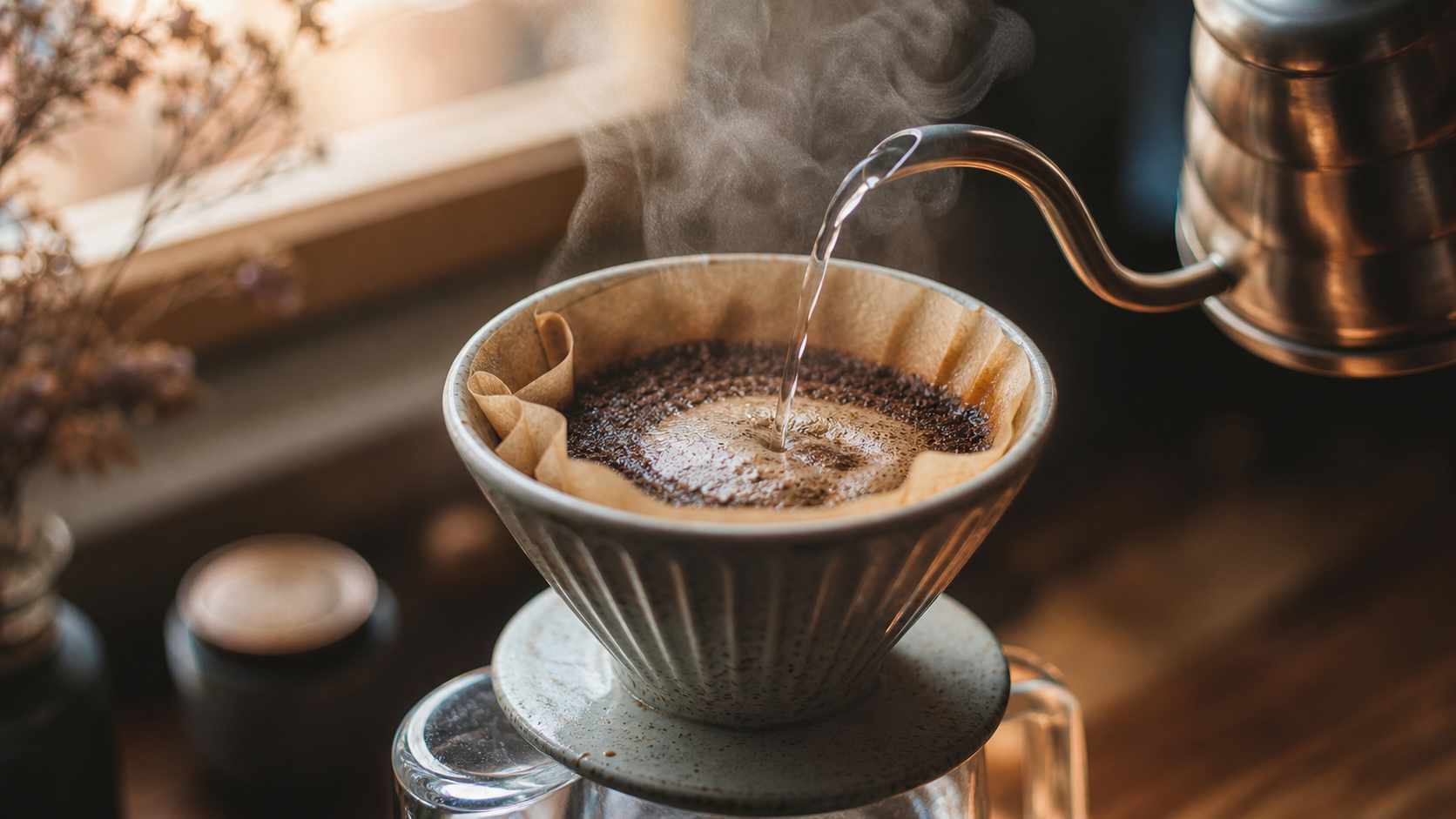
Coffee-to-Water Ratio: The Golden Ratio for Brewing (2026)
A coffee recipe that turns out to be a math lesson in disguise
Two people brew with the same beans, the same grinder, and the same water. One cup comes out thin and sour; the other comes out heavy and bitter. They blame the beans, or the machine, or the roast. The real culprit is almost always a single number that home recipes mention only vaguely and that specialty baristas weigh to the gram: the ratio of coffee to water.
Get that ratio right and an ordinary bean tastes balanced. Get it wrong and a world-class bean tastes flat or harsh. This article unpacks what the coffee-to-water ratio really is, where the famous "golden ratio" comes from, and the deeper number hiding behind it all — extraction yield — which is what actually decides whether your coffee tastes sour, sweet, or bitter.
What the Coffee-to-Water Ratio Actually Is
The coffee-to-water ratio is simply the weight of dry coffee compared to the weight of brewing water, written as 1:N. A 1:16 ratio means 1 gram of coffee for every 16 grams of water. Because water is almost exactly 1 gram per milliliter, 16 grams of water is also 16 mL, so the ratio works whether you weigh in grams or measure in milliliters. It is the single setting that controls how strong or weak your cup will be.
The reason baristas insist on weighing instead of scooping is that a "scoop" is not a fixed amount. Coffee beans vary in density by roast level and origin, and ground coffee settles differently every time, so a tablespoon can hold anywhere from 5 to 7 grams. Volume measures quietly change your ratio from cup to cup, which is exactly why "the same recipe" keeps producing different results. A scale removes the guesswork and makes the ratio repeatable.
This is the same normalization trick that shows up across food and drink. It is the instinct behind a rice-to-water ratio that is not a fixed multiple, and behind pizza dough written as baker's percentage — expressing one ingredient relative to another so the relationship, not the absolute amount, becomes the thing you control.
The Golden Ratio: Why 1:18 (and the 1:15–1:17 Band)
The "golden ratio" for coffee comes from the Specialty Coffee Association's Golden Cup standard, which targets roughly 55 grams of coffee per litre of water - about 1:18 - as the point where a filter brew lands in its ideal balance of strength and extraction. In practice, most home brewers prefer a touch stronger and use the 1:15 to 1:17 band for pour-over and drip. Espresso is a different regime entirely, running around 1:2. There is no single "correct" ratio, only a target you tune to taste.
The Golden Cup standard is not folklore; it grew out of mid-twentieth-century brewing research and is anchored to two measurable targets — a strength (total dissolved solids) of about 1.15 to 1.35 percent, and an extraction yield of 18 to 22 percent. The 1:18 ratio is the coffee dose that tends to land a typical filter brew inside that window. Pull the ratio tighter, toward 1:15, and you get a more concentrated, intense cup; loosen it toward 1:17, and you get something lighter and brighter.
Notice what the ratio does and does not do. It fixes the proportion of coffee to water, which sets how strong the cup is. It does not, by itself, guarantee good flavor — two brewers can hit the exact same 1:16 ratio and still get very different cups if one grinds too coarse or pours too fast. The ratio is the strength dial; flavor needs a second number, which we get to at the end.
Brew Ratio, Worked Out in Grams
To turn a ratio into a real brew, pick your coffee dose and multiply by the ratio to get the water. At 1:16, a 20-gram dose needs 20 x 16 = 320 grams of water - a generous single mug. Want a smaller cup? Scale the coffee down and the water follows automatically: 15 grams at 1:16 is 240 grams of water. The ratio stays fixed; only the dose changes, which is the entire point of thinking in ratios instead of fixed recipes.
Here is the same 1:16 ratio expressed as a few common doses, so you can see how cleanly it scales. Each row is the same formula with a different starting weight plugged in.
| Coffee dose | Ratio | Water (g ≈ mL) | Roughly |
|---|---|---|---|
| 15 g | 1:16 | 240 g | One small cup |
| 20 g | 1:16 | 320 g | everyday one large mug |
| 30 g | 1:16 | 480 g | Two cups |
| 60 g | 1:16 | 960 g | A full carafe |
You want exactly 500 g of brewed coffee at a balanced 1:16. Work backward:
Prefer it stronger? Use 1:15 instead: 500 ÷ 15 = 33 g of coffee for the same amount of water.
This is exactly the kind of repetitive arithmetic an AI assistant handles instantly. You are not asking it to invent a recipe — you are handing it a fixed rule and a number to plug in, which is where these tools are genuinely reliable.
(Role) You are a coffee brewing assistant. (Context) I brew pour-over at a 1:16 coffee-to-water ratio. (Task) Tell me the grams of coffee and water for a [350 mL] cup. (Format) Two short lines, grams only.
For a 350 mL (350 g) cup at 1:16:
Coffee: 350 ÷ 16 = 21.9 g (round to 22 g)
Water: 22 × 16 = 352 g — essentially your 350 mL target.
1:15 vs 1:16 vs 1:17 — How the Ratio Changes the Cup
Within the everyday filter range, a single point of ratio is a noticeably different cup. At 1:15, the coffee is concentrated and intense, with more body and a stronger finish. At 1:16, it sits in a balanced middle - the safe everyday default most people reach for. At 1:17, the cup is lighter and brighter, with more clarity and a thinner mouthfeel that flatters delicate, fruity beans. None is objectively best; they are different targets for different beans and moods.
The trade-off across the band is intensity versus clarity. A tighter ratio (more coffee per unit water) gives you a denser, more powerful cup that can overwhelm subtle flavors. A looser ratio (less coffee per unit water) lets origin character and acidity come forward but can tip into watery if you go too far. The right choice depends on the bean: a heavy dark roast often shines at 1:16, while a bright washed coffee can sing at 1:17.
These bands are taste consensus, not hard rules. Grind size, water temperature, and brew time all interact with the ratio.
| Ratio | Strength | Mouthfeel & character | Best for |
|---|---|---|---|
| 1:15 | Strong, concentrated | Heavy body, bold finish | intense dark roasts, milk drinks |
| 1:16 | Balanced | Round, versatile, forgiving | all-round everyday default |
| 1:17 | Lighter, brighter | Clean, more acidity, tea-like | delicate light roasts, fruity beans |
If a cup is off, the ratio is the first dial to try, and you adjust it in small steps. Too weak and watery? Tighten the ratio by a point — go from 1:17 to 1:16. Too heavy or muddy? Loosen it the other way. Because it is just arithmetic, these corrections are precise and repeatable instead of vague "add a bit more coffee" guesswork.
The Number Behind the Ratio: Extraction Yield
Here is the twist: the ratio controls how strong your coffee is, but it does not control how it tastes. That job belongs to extraction yield - the percentage of the coffee's mass that actually dissolves into the water. The SCA target is 18 to 22 percent. Below 18 percent the coffee is under-extracted and tastes sour, thin, and salty; above 22 percent it is over-extracted and tastes bitter, harsh, and dry. Ratio sets the concentration; yield sets the flavor.
This is why two people can hit the exact same 1:16 ratio and still produce a sour cup and a bitter cup. The ratio fixes how much coffee meets how much water, but how much of that coffee ends up in the cup depends on grind size, water temperature, and contact time. A coarse grind or a fast pour extracts too little and tastes sour; a fine grind or a long steep extracts too much and tastes bitter. Yield is the lever those variables actually move.
So the two numbers do different jobs, and you tune them with different tools. To change strength, change the ratio (more or less coffee per unit water). To change taste balance, change the extraction — adjust grind size first, then time and temperature. Keeping these separate in your head is the single biggest upgrade most home brewers can make: a sour cup is rarely fixed by adding more coffee; it is fixed by grinding finer so the same dose extracts more fully.
(Role) You are a coffee troubleshooting assistant. (Context) My pour-over at 1:16 tastes sour and thin. (Task) Tell me whether this is a ratio problem or an extraction problem, and the first fix. (Format) One sentence diagnosis, one sentence fix.
Diagnosis: sour and thin points to under-extraction, not a ratio issue - you are dissolving too little of the coffee.
First fix: grind finer (and/or extend brew time slightly) to push extraction up toward the 18–22% target, keeping your 1:16 ratio unchanged.
This is the same shift that separates following a recipe from understanding a system. Once you see that strength and flavor are two different numbers, coffee stops being trial-and-error and becomes adjustable. It is the same ratio-thinking that turns up in the salt-and-temperature math of kimchi fermentation and in the frequency ratios behind musical harmony — name the ratio, isolate the variables, and a fragile process becomes something you can repeat on purpose.
Frequently Asked Questions
What is a good coffee-to-water ratio?
For pour-over and drip coffee, a ratio between 1:15 and 1:17 suits most people, with 1:16 (1 gram of coffee per 16 grams of water) being the reliable everyday default. A 1:15 ratio gives a stronger, heavier cup; 1:17 gives a lighter, brighter one. The Specialty Coffee Association's Golden Cup target is about 1:18 (roughly 55 grams of coffee per litre of water). There is no single correct number, so start at 1:16 and adjust by a point in either direction to taste.
What is the golden ratio for coffee?
The "golden ratio" refers to the Specialty Coffee Association's Golden Cup standard, which targets roughly 55 grams of coffee per litre of water - about 1:18 - as the point where a filter brew reaches its ideal balance. It is tied to two measurable goals: a strength (total dissolved solids) of about 1.15 to 1.35 percent and an extraction yield of 18 to 22 percent. Many home brewers prefer a slightly stronger 1:16, but the Golden Cup is the standard the term comes from.
How much coffee do I use per cup of water?
Multiply your water amount by the ratio, working in grams. At 1:16, a 240 mL cup (240 grams of water) needs 240 divided by 16, which is 15 grams of coffee. A larger 350 mL cup needs about 22 grams. Because water weighs almost exactly 1 gram per millilitre, you can read millilitres as grams. The cleanest approach is to weigh both coffee and water on a scale rather than relying on scoops, which vary in how much they hold.
Is a 1:15 or a 1:17 ratio stronger?
A 1:15 ratio is stronger. The smaller the second number, the more coffee there is relative to the water, so 1:15 packs more coffee into the same volume than 1:17 does. 1:15 produces a concentrated, heavy-bodied cup well suited to dark roasts and milk drinks, while 1:17 yields a lighter, brighter, more tea-like cup that flatters delicate, fruity beans. 1:16 sits in the middle as a balanced everyday choice.
What is coffee extraction yield?
Extraction yield is the percentage of a coffee's dry mass that dissolves into the water during brewing, and it is the number that actually controls flavor. The Specialty Coffee Association targets 18 to 22 percent. Below 18 percent the coffee is under-extracted and tastes sour, thin, and salty; above 22 percent it is over-extracted and tastes bitter, harsh, and astringent. While the ratio sets how strong the cup is, extraction yield - driven by grind size, water temperature, and contact time - sets whether it tastes balanced.
Why does my coffee taste bitter or sour?
Sour, thin coffee is usually under-extracted, meaning too little of the coffee dissolved; the fix is to grind finer, brew a little longer, or use hotter water so extraction rises toward the 18 to 22 percent target. Bitter, harsh coffee is usually over-extracted, meaning too much dissolved; grind coarser, shorten the brew, or lower the water temperature. Crucially, both are extraction problems, not ratio problems - adding or removing coffee changes strength, not the sour-versus-bitter balance, so adjust grind and time first.
Get new posts by email
No ads. Unsubscribe anytime.
Comments
Comments (0)
Leave a Comment