Salad Dressing Ratio: The Vinaigrette Math (3:1 and Beyond)
A salad-dressing recipe that turns out to be a lesson in ratios
Everyone has tasted a vinaigrette that went wrong. One is a sharp slap of vinegar that makes you wince; another is a slick of oil that just coats the leaves and tastes flat. Same three ingredients - oil, vinegar, a pinch of salt - and yet the results are nowhere near each other. The difference is almost never the brand of olive oil or the fancy vinegar. It is a single number that most recipes mumble and that cooks who never measure keep getting wrong: the ratio of oil to vinegar.
Get that ratio right and a cheap oil and an ordinary vinegar taste bright and balanced. Get it wrong and the best bottle in the cupboard tastes harsh or greasy. This article unpacks what the salad dressing ratio actually is, why the classic vinaigrette is built on 3 parts oil to 1 part vinegar, how to shift it for a lighter or sharper dressing, and the quieter math hiding underneath it all - the emulsion - which is what decides whether your dressing stays creamy or splits back into a puddle of oil and acid.
What the Salad Dressing Ratio Actually Is
A salad dressing ratio is the proportion of oil to acid - usually vinegar or citrus juice - in a vinaigrette, written as parts, like 3:1. A 3:1 ratio means 3 parts oil for every 1 part vinegar: three tablespoons of oil to one tablespoon of vinegar, for example. Because it is a ratio of parts, not fixed amounts, it scales to any batch size - the relationship stays the same whether you are dressing one salad or a bowl for twelve. It is the single setting that controls whether a dressing tastes sharp, balanced, or rich.
The reason "parts" beats a fixed recipe is that one ingredient keeps changing. A mild rice vinegar at 4% acidity is far gentler than a 7% red wine vinegar, and a lemon is gentler still and varies fruit to fruit. If you lock in "two tablespoons of vinegar" as a rule, the dressing swings from soft to sour depending on which bottle you grabbed. Thinking in parts lets you hold the balance steady and adjust the amounts - exactly the normalization trick behind a coffee-to-water ratio or a baker's percentage.
It is the same instinct that turns up across the kitchen: the coffee-to-water ratio that fixes a brew's strength, and pizza dough written as baker's percentage - expressing one ingredient relative to another so the relationship, not the absolute amount, becomes the thing you control.
Why 3:1 Is the Classic Vinaigrette
The classic vinaigrette ratio is 3 parts oil to 1 part vinegar, a proportion cooking schools and standard culinary references have taught for generations. At 3:1 the oil rounds out and carries the flavors while the acid stays bright enough to cut through richness without dominating - the balance point where neither side wins. It is a starting point, not a law: many cooks prefer a sharper 2:1, and richer or more bitter oils sometimes want 4:1. But 3:1 is the default that reliably lands "balanced" for most oils and vinegars.
Why does this particular proportion work? Acid is powerful and oil is mellow. A little vinegar goes a long way - it is concentrated sourness, and your palate registers it fast - while oil is a smooth, fatty background that needs more volume to make its presence felt. Three to one roughly matches the perceived intensity of the two: enough oil to build body and mouthfeel, just enough acid to keep it lively. Tip past about 2:1 toward more acid and the dressing reads as a "sharp" or "bright" vinaigrette; tip below 4:1 toward more oil and it reads as "mellow" or even "rich."
Notice what the ratio does and does not do. It fixes the proportion of oil to acid, which sets how sharp or rich the dressing reads. It does not, by itself, guarantee a dressing that holds together - two cooks can hit the exact same 3:1 and still end up with one creamy dressing and one that splits into layers within a minute. The ratio is the flavor dial; staying mixed needs a second piece of math, which we get to at the end.
2:1 vs 3:1 vs 4:1 — How the Ratio Changes the Dressing
Within the everyday vinaigrette range, a single step of ratio is a clearly different dressing. At 2:1 the dressing is bright and sharp, with the acid forward - good for rich, fatty foods and sturdy greens that can take a punch. At 3:1 it sits balanced, the all-purpose default. At 4:1 it is mellow and oil-forward, gentle enough for delicate leaves and sweet additions. None is objectively best; they are different targets for different salads.
The trade-off across the band is brightness versus richness. A tighter ratio (more acid per unit oil) gives a livelier, more cutting dressing that wakes up heavy ingredients but can overwhelm a delicate butter lettuce. A looser ratio (more oil per unit acid) gives a rounder, silkier dressing that flatters tender greens but can taste flat or greasy on robust ones. The right choice depends on what you are dressing: a hearty kale or radicchio salad shines at 2:1, while a soft spring mix often wants 4:1.
These bands are taste consensus, not hard rules. The acid's strength, the oil's character, and what you are dressing all interact with the ratio.
| Ratio (oil:acid) | Character | Mouthfeel | Best for |
|---|---|---|---|
| 2:1 | Bright, sharp | Lean, cutting, acid-forward | sharp rich foods, sturdy greens (kale, radicchio) |
| 3:1 | Balanced | Round, versatile, forgiving | all-round everyday default |
| 4:1 | Mellow, rich | Silky, oil-forward, soft | delicate tender leaves, sweet or fruity salads |
Turning a ratio into a real batch is just multiplication. Pick how much finished dressing you want, split it by the ratio's parts, and pour. At 3:1 the oil is three-quarters of the volume and the acid is the remaining quarter; at 2:1 the acid grows to a third. Because it is arithmetic, scaling up for a crowd or dialing in a sharper dressing is precise instead of guesswork.
You want about 1 cup (240 mL) of finished vinaigrette at a classic 3:1. The 4 parts split as 3 oil + 1 acid:
Prefer it brighter? At 2:1 the 3 parts split 2 oil + 1 acid: oil = 2/3 cup (160 mL), vinegar = 1/3 cup (80 mL).
This is exactly the kind of repetitive arithmetic an AI assistant handles instantly. You are not asking it to invent a recipe - you are handing it a fixed rule and a number to plug in, which is where these tools are genuinely reliable.
(Role) You are a cooking assistant. (Context) I make vinaigrette at a 3:1 oil-to-vinegar ratio plus about 1% salt by weight. (Task) Give me the grams of oil, vinegar, and salt for [200 g] of finished dressing. (Format) Three short lines, grams only.
For 200 g of dressing at 3:1 (3 parts oil + 1 part acid = 4 parts):
Oil: 200 × 3/4 = 150 g
Vinegar: 200 × 1/4 = 50 g
Salt: 200 × 0.01 = 2 g (about 1/3 tsp fine salt)
The Hidden Math: Salt Percentage and the Emulsion
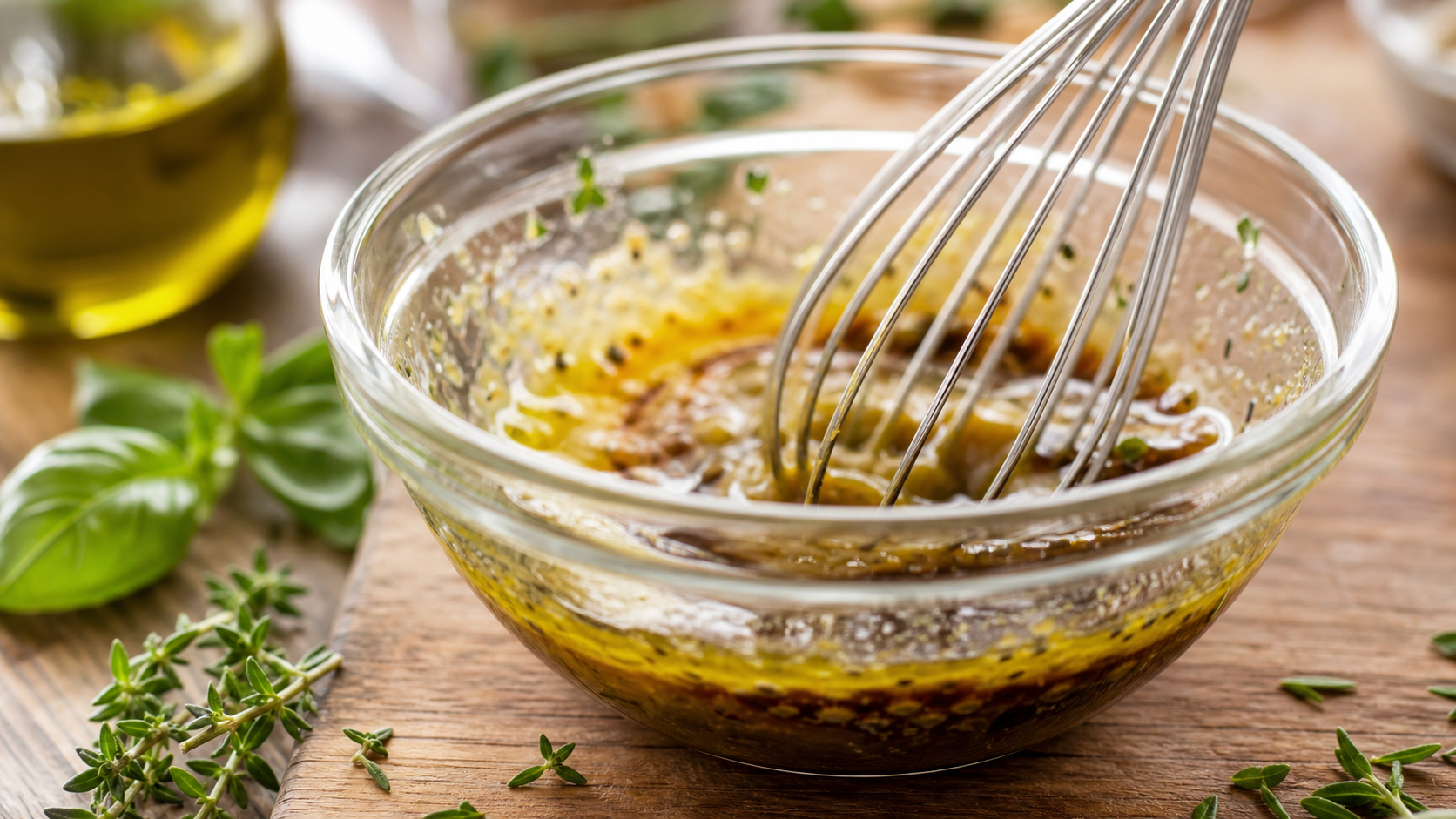
Two numbers hide under the oil:vinegar ratio. The first is salt: a well-seasoned dressing is roughly 1% salt by total weight, the same baseline that makes most savory food taste "right." The second is the emulsion - oil and vinegar do not naturally mix, so a vinaigrette is a temporary suspension of tiny oil droplets in the acid. Whisking forces them together, but they drift apart within minutes unless an emulsifier (most commonly mustard, about 1 teaspoon per quarter-cup of dressing) keeps the droplets separated and the dressing creamy.
The salt number is easy to apply: weigh your dressing and aim for about 1% - roughly a quarter teaspoon of fine salt per 60 grams. The emulsion is the more interesting math. Left alone, oil and vinegar separate because oil is less dense and the two are chemically unwilling to bond; the mixture's surface tension pulls the oil back into a single layer to minimize contact with the water-based acid. An emulsifier like mustard - or egg yolk, or a little honey - carries molecules that like both oil and water, so they park at the boundary of every droplet and stop them from merging. That is why a spoonful of mustard turns a vinaigrette that splits in 30 seconds into one that holds for the whole meal.
So the numbers do different jobs, and you tune them with different moves. To change flavor balance, change the ratio (more or less acid per unit oil). To change seasoning, target about 1% salt. To stop the dressing from splitting, add an emulsifier and whisk while you drizzle the oil in slowly. Keeping these separate in your head is the biggest upgrade most home cooks can make: a dressing that breaks is rarely fixed by changing the oil-to-vinegar ratio - it is fixed by adding mustard and emulsifying properly.
(Role) You are a cooking troubleshooting assistant. (Context) My 3:1 vinaigrette tastes balanced but separates into oil and vinegar within a minute of whisking. (Task) Tell me whether this is a ratio problem or an emulsion problem, and the first fix. (Format) One sentence diagnosis, one sentence fix.
Diagnosis: separating is an emulsion problem, not a ratio one - your 3:1 flavor is fine, but the oil droplets have nothing keeping them suspended.
First fix: whisk in about 1 tsp mustard per 1/4 cup of dressing, then drizzle the oil in slowly while whisking so the emulsifier can coat each droplet.
This is the same shift that separates following a recipe from understanding a system. Once you see that flavor, seasoning, and stability are three different numbers, dressing stops being trial-and-error and becomes adjustable. It is the same ratio-thinking that turns a fragile process into something repeatable - the way a rice-to-water ratio that is not a fixed multiple turns a pot of rice from a gamble into a routine: name the ratio, isolate the variables, and you can repeat the good version on purpose.
Frequently Asked Questions
What is the ratio for salad dressing?
The standard salad dressing ratio for a vinaigrette is 3 parts oil to 1 part acid (vinegar or citrus juice), written 3:1 - for example, 3 tablespoons of oil to 1 tablespoon of vinegar, plus a pinch of salt. Because it is a ratio of parts rather than fixed amounts, it scales to any batch. Many cooks adjust within a 2:1 (sharper, more acidic) to 4:1 (milder, more oil) range depending on the salad and the strength of the vinegar, so 3:1 is the reliable starting point rather than the only correct answer.
What is the classic vinaigrette ratio of oil to vinegar?
The classic vinaigrette ratio is 3:1 - three parts oil to one part vinegar - the proportion taught in standard culinary references and cooking schools. At 3:1 the oil builds body and carries flavor while the acid stays bright enough to cut richness without taking over. It is a default, not a rule: brighter, modern dressings often use 2:1, and richer oils sometimes call for 4:1. Start at 3:1, taste, and adjust by shifting one part of oil or acid up or down.
Is a 3:1 or a 2:1 vinaigrette better?
Neither is universally better - they are different targets. A 3:1 vinaigrette is balanced and all-purpose, good for most salads and the safe everyday default. A 2:1 vinaigrette is sharper and more acidic, which suits rich or fatty foods and sturdy greens like kale and radicchio that can stand up to it. For delicate leaves or sweeter salads, a milder 4:1 is often better still. Match the ratio to the salad: the heartier and richer the dish, the more acid (lower oil-to-vinegar ratio) it can take.
How much salt goes in salad dressing?
A common guideline is to season a dressing to roughly 1% salt by total weight, the same baseline that makes most savory food taste properly seasoned. That works out to about 2 grams of salt - around a third of a teaspoon of fine salt - per 200 grams of finished dressing, or about a quarter teaspoon per 60 grams. Salt is easiest to judge by tasting the dressing on a leaf rather than on its own, since it reads differently once it coats the greens. Add it gradually and taste as you go.
Why does my vinaigrette separate, and how do I keep it from splitting?
A plain vinaigrette separates because oil and vinegar do not naturally mix - whisking only creates a temporary suspension of oil droplets in the acid, and surface tension soon pulls the oil back into its own layer. To keep it from splitting, add an emulsifier such as mustard (about 1 teaspoon per quarter-cup of dressing), egg yolk, or a little honey; these carry molecules that like both oil and water and sit at the surface of each droplet to stop them merging. Whisk the emulsifier with the acid first, then drizzle the oil in slowly while whisking so a stable, creamy emulsion forms.
How do I scale a vinaigrette to a bigger batch?
Because a vinaigrette is defined by a ratio, scaling is just multiplication - keep the proportion fixed and multiply every ingredient by the same number. At 3:1, the oil is always three-quarters of the total and the acid is one-quarter, so 1 cup of dressing is 3/4 cup oil plus 1/4 cup vinegar, and 2 cups is simply double: 1.5 cups oil plus 1/2 cup vinegar. Keep salt at about 1% of the new total weight and scale the emulsifier with the volume too (roughly 1 teaspoon of mustard per quarter-cup). The relationship never changes; only the amounts do.
Get new posts by email
No ads. Unsubscribe anytime.
Comments
Comments (0)
Leave a Comment