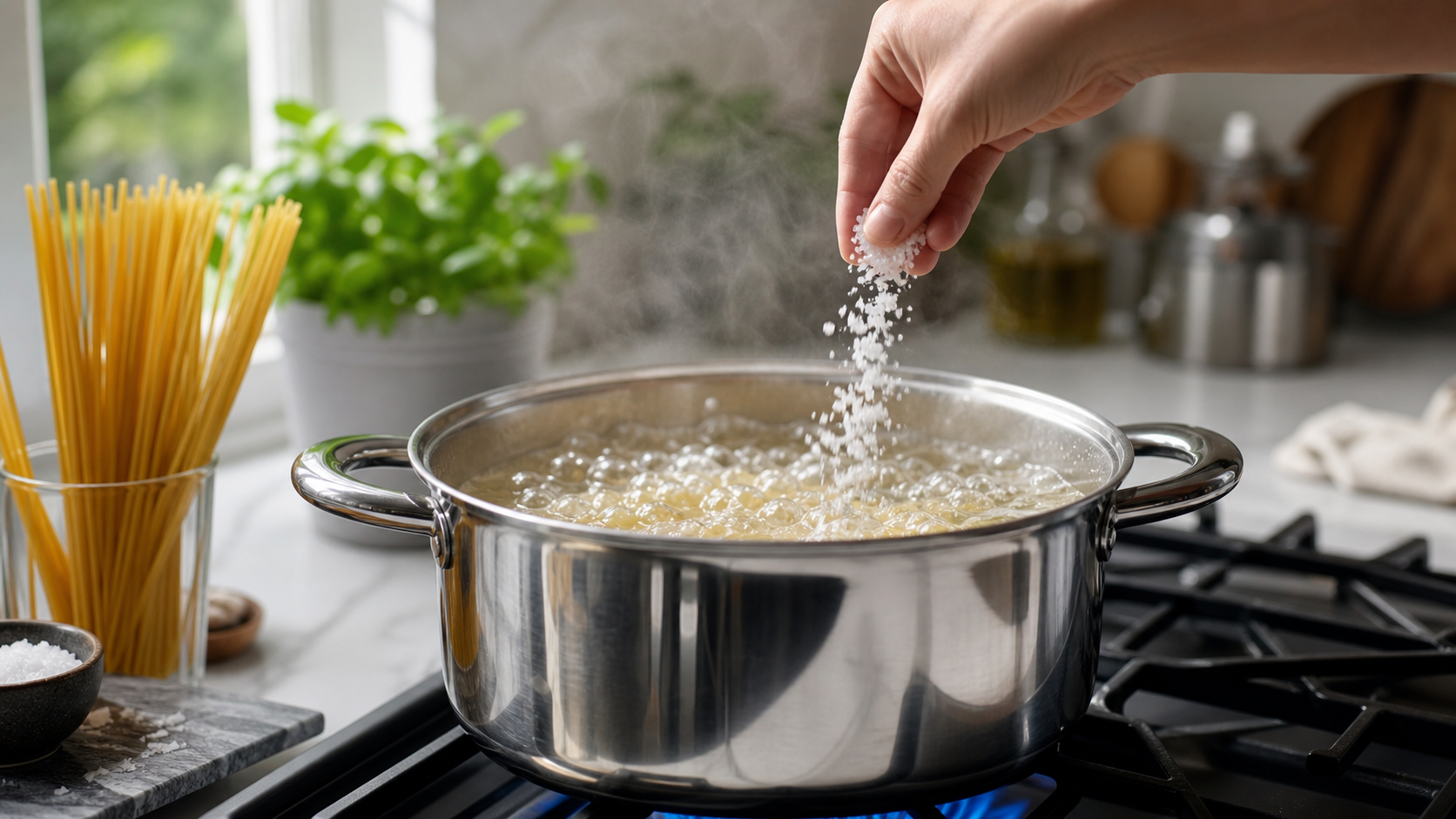
How Much Salt in Pasta Water? The 1% Ratio Explained (2026)
A kitchen rule of thumb that turns out to be one tidy percentage
Every recipe says it. Every confident cook repeats it: "salt your pasta water until it tastes like the sea." It sounds authoritative, even a little romantic. It is also, taken literally, the most common reason home pasta ends up either flat and under-seasoned or weirdly briny. The advice worth following isn't a taste memory at all — it's a number.
That number is small, exact, and the same no matter how big your pot is. Once you see "salt it like the sea" for what it really is — a percentage of salt by the weight of the water — you can season any pot, every time, without tasting, guessing, or flinging a fistful of salt and hoping. This is a recipe rule that turns out to be a math lesson in disguise.
How Much Salt Per Liter of Pasta Water?
Use about 1% salt by the weight of your water — roughly 10 grams of salt for every 1 liter (1000 grams) of water. That is close to two level teaspoons of fine table salt per liter, or a slightly heaped tablespoon. Most professional kitchens land somewhere between 1% and 2%; 1% is a clean, reliable starting point that seasons the pasta well without overpowering the sauce it will meet later. Because the rule is a percentage, it scales to any pot size with simple multiplication.
The trick that makes this foolproof is measuring salt against the water, not the pasta and not "to taste." Water is easy to measure: 1 liter weighs almost exactly 1000 grams. So "1% salt" becomes the very concrete "10 grams per liter," and a 4-liter pot — a normal amount for a pound of spaghetti — wants about 40 grams. No tasting a scalding pot required.
This is the same instinct that runs through nearly all kitchen ratios: pin one ingredient to another and the relationship, not the raw amount, becomes the thing you control. It is exactly how a coffee-to-water golden ratio works, and how bakers anchor everything to flour in pizza dough's baker's percentage. Salt in pasta water is just the savory cousin.
"Salty Like the Sea" Is Actually Too Much
Real seawater is about 3.5% salt by weight — roughly 35 grams per liter, according to NOAA's average ocean salinity figure. That is about three and a half times saltier than the ~1% pasta-water target. So taken literally, "salt it like the sea" tells you to use over three times the salt most cooks actually want. The phrase is a vibe, not a measurement: it captures "salt it generously," but following it precisely gives you punishingly salty water and pasta that fights its sauce.
The gap is easy to picture as percentages on a single scale. Plain tap water sits near 0%. A well-seasoned pasta pot lives around 1%. The ocean is way out at 3.5%. The popular instruction quietly points you at the wrong end of that line, which is why "season like the sea" so often overshoots.
The bar is scaled to salinity: the "sea" segment really is over three times the width of the 1% target. The metaphor is directionally right ("salt it") but numerically far too high.
| Target | Salt % | Per 1 L water | Result |
|---|---|---|---|
| Unsalted | 0% | 0 g | Flat, bland pasta |
| Pasta-water target | 1% | 10 g | just right seasoned, sauce-friendly |
| Bold / pro upper end | 2% | 20 g | assertive for plain or buttered pasta |
| "Like the sea" (literal) | 3.5% | 35 g | too much harsh, overpowers sauce |
None of this means the metaphor is useless — it exists to stop people from forgetting salt entirely, which is a real and worse mistake. But as a number, aim for the 1% end of the scale, not the literal ocean. Salt percentages governing a result is the same math behind the salt percentage that controls kimchi fermentation, where a few points of salinity decide whether the result is crisp and lively or mushy and over-salted.
How Much Salt Does Pasta Actually Absorb?
Most of the salt you add never enters the pasta — it stays in the cooking water and goes down the drain when you strain it. Pasta seasons mainly at its surface as it cooks, picking up only a small fraction of the dissolved salt. What pasta actually absorbs in quantity is water: dry pasta takes on roughly 75–100% of its own weight in water, nearly doubling, while taking up comparatively little salt. That's why under-salting the water can't really be fixed by salting the drained pasta later: the seasoning has to happen while it cooks.
This reframes what the 1% is even for. You are not trying to load the pasta with all that salt — you are creating a seasoned bath so the noodle absorbs seasoned water and finishes evenly salted from the inside, not just dusted on top. The large amount of salt in the pot relative to what ends up in the pasta is exactly why the water tastes saltier than the cooked pasta does, and why the "season the water generously" idea exists in the first place.
It also explains the famous tip to save a ladle of starchy pasta water for the sauce: that water carries both dissolved starch and some of your dissolved salt, so it seasons and emulsifies the sauce at the same time. The salt you "lost" to the pot isn't entirely wasted if you put a little of that water back to work.
Scaling the Ratio: Salt for Any Pot Size
Because the rule is a percentage, you never re-guess — you just multiply. Salt (in grams) equals the water's weight in grams times 0.01 for a 1% solution. A liter of water weighs 1000 g, so each liter wants 10 g of salt; a 4-liter pot wants 40 g; a small 1.5-liter pot for a single serving wants 15 g. Want it bolder at 1.5%, multiply by 0.015 instead. The same one-line formula covers every pot you will ever use, which is the whole advantage of thinking in ratios instead of memorizing amounts.
Here is the scaling laid out for common pot sizes, at both the standard 1% and a bolder 1.5%. Find your water volume, read across.
| Water | Weight | Salt at 1% | Salt at 1.5% | Rough spoon (1%, fine salt) |
|---|---|---|---|---|
| 0.5 L | 500 g | 5 g | 7.5 g | ~1 tsp |
| 1 L | 1000 g | 10 g | 15 g | ~2 tsp |
| 2 L | 2000 g | 20 g | 30 g | ~1.3 tbsp |
| 3 L | 3000 g | 30 g | 45 g | ~2 tbsp |
| 4 L | 4000 g | 40 g | 60 g | ~2.7 tbsp |
| 6 L | 6000 g | 60 g | 90 g | ~4 tbsp |
You fill a big pot with 4 liters of water for a pound of spaghetti. At the 1% target:
Prefer it punchier? Salt = 4000 × 0.015 = 60 g. No tasting the boiling pot, no fistful-and-pray.
This is also a place where a quick AI assist saves arithmetic — not to invent anything, just to do the multiply instantly once you give it the rule.
(Role) You are a kitchen math helper. (Context) I salt pasta water at 1% by weight; 1 liter of water = 1000 g. (Task) How much salt for [3.5 liters] of water? Also give me the 1.5% version. (Format) One short line per percentage, grams only.
At 1%: 3500 g × 0.01 = 35 g of salt.
At 1.5%: 3500 g × 0.015 = 52.5 g of salt.
That seasons 3.5 L of water; reserve a little of the starchy water for your sauce.
The same "pick a base amount, multiply each ingredient by its ratio" move powers a rice-to-water ratio and the classic 3:1 oil-to-vinegar of a vinaigrette ratio. Learn the pattern once and most of cooking-by-numbers comes free.
Does Salt Change Boiling Point or Cook Time?
Not in any way you'd notice. Adding salt does raise water's boiling point — that's a real effect called boiling-point elevation — but at culinary amounts it is tiny. Around 10 grams of salt per liter raises the boiling point by only a few hundredths of a degree Celsius, far too little to speed up or slow down cooking in any meaningful way. Salt in pasta water is about flavor, full stop. If anything, you add salt for seasoning, not to "make the water boil hotter" or cook faster.
Boiling-point elevation is a colligative property: it depends on how many dissolved particles are in the water, following ΔT = K×molality. The catch is that a pasta pot is dilute. Ten grams of table salt in a liter is a low concentration in chemistry terms, so the temperature bump is a rounding error against the energy your stove pumps in. The myth that "salt makes water boil faster" gets the direction wrong twice over: salt slightly raises the boiling point, and the change is too small to matter either way.
Frequently Asked Questions
How much salt do I put in pasta water?
Use about 1% salt by the weight of the water, which is roughly 10 grams of salt per 1 liter (1000 grams) of water. For a typical 4-liter pot that's about 40 grams. Measuring by weight is most reliable because salt types vary a lot by volume; if you only have spoons, 1 liter is close to two level teaspoons of fine table salt. Many cooks go up to 1.5–2% for bolder seasoning, but 1% is a dependable starting point.
Should pasta water really taste like the sea?
Not literally. Seawater is about 3.5% salt by weight (around 35 grams per liter), while well-seasoned pasta water is closer to 1% (about 10 grams per liter). Following "salty like the sea" exactly gives you over three times as much salt as most cooks want, producing harsh, overpowering water. The phrase is meant to remind you to salt generously, but as an actual measurement it overshoots — aim for the 1% end of the scale instead.
How much salt per liter of pasta water?
About 10 grams of salt per 1 liter of water for a 1% solution, since 1 liter of water weighs roughly 1000 grams. Scale it by multiplying: 2 liters wants 20 grams, 4 liters wants 40 grams, 6 liters wants 60 grams. If you prefer bolder pasta, use 15 grams per liter (1.5%). The formula is simply salt (g) = water (g) × 0.01.
Does salt make pasta water boil faster?
No. Salt actually raises water's boiling point slightly through an effect called boiling-point elevation, but at cooking amounts (about 10 grams per liter) the rise is only a few hundredths of a degree Celsius — far too small to change cook time. Salt does not make the water boil faster or hotter in any meaningful way; it is added purely for flavor. A covered pot and a strong burner affect boiling speed far more than salt does.
Is it bad to not salt pasta water?
It won't harm anything, but the pasta will taste noticeably flat and bland, and you can't fully fix it afterward. Pasta seasons mainly while it cooks, absorbing seasoned water from the inside; salt sprinkled on the drained pasta later sits on the surface and tastes sharp and uneven. Because most of the salt stays in the water and drains away, salting the cooking water is the only way to season pasta evenly throughout.
What kind of salt is best for pasta water, and does it change the amount?
Any salt works, because the 1% target is by weight, not by volume — so 10 grams of fine table salt and 10 grams of coarse kosher salt season the water the same. The amount only "changes" if you measure by spoon: a tablespoon of fluffy kosher salt weighs much less than a tablespoon of dense table salt, so the same spoon delivers different amounts. Weighing in grams removes that confusion entirely and makes the ratio exact.
Get new posts by email
No ads. Unsubscribe anytime.
Comments
Comments (0)
Leave a Comment